RED-EYED SASQUATCH BLUFF CHARGES TEAM IN TENNESSEE | ARCHIVES
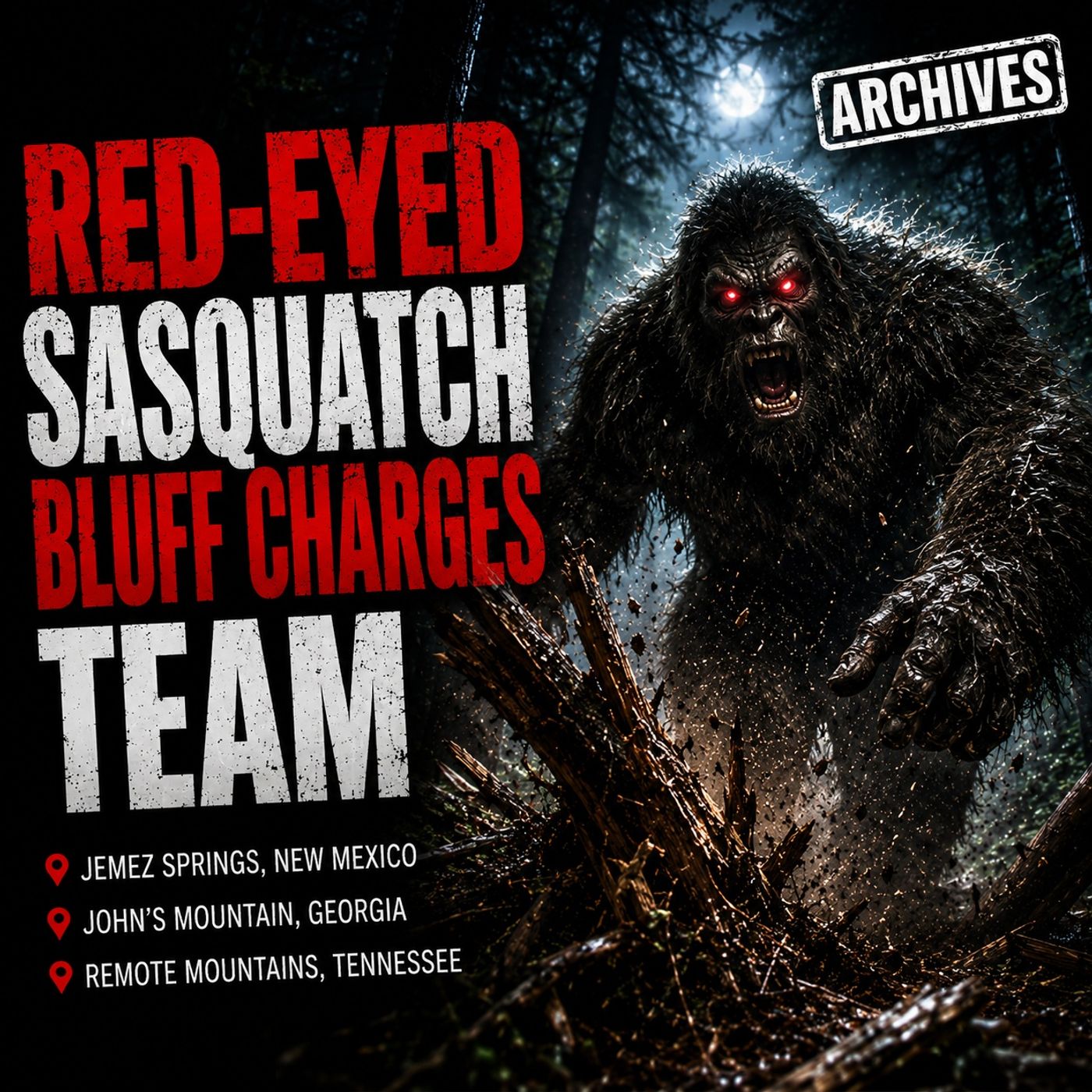
Originally released as Episode 1148 of Bigfoot Society What happens when a psychologist spends hundreds of hours searching for Sasquatch? In this archived conversation, Dr. John Baranchok shares the encounters that convinced him something...

 Apple Podcasts

 Spotify

 Castro

 RSS Feed
Originally released as Episode 1148 of Bigfoot Society
What happens when a psychologist spends hundreds of hours searching for Sasquatch?
In this archived conversation, Dr. John Baranchok shares the encounters that convinced him something extraordinary is moving through the forests of North America. From unexplained rock-throwing incidents in the mountains of New Mexico to a terrifying nighttime encounter in Tennessee involving a possible bluff charge, glowing red eyes, and a massive footprint cast, this episode is packed with firsthand experiences from years of field research.
John also discusses the science of Bigfoot investigation, how researchers can prepare themselves for high-intensity encounters, the role of perception in the wilderness, reports of mindspeak and telepathy, and why experimental research may hold the key to understanding the phenomenon.
Locations discussed include New Mexico, Georgia, Tennessee, Kentucky, and the Appalachian Mountains.
If you've ever wondered what decades of field experience can teach us about Sasquatch, this is an episode you won't want to miss.
Resources:
Grasping Sasquatch: Prepping for Scientific Field Research by Dr. John Baranchok - https://amzn.to/3Ttt1pe (Amazon Affiliate Link)
The Nephilim Among Us Updated by Scott Carpenter - https://amzn.to/3TwDiRJ (Amazon Affiliate link)
Bigfoot Prep on Facebook - https://www.facebook.com/profile.php?id=100028871298666
Contact John on Facebook - https://www.facebook.com/john.baranchol
📖 Follow Jeremiah's cancer health updates here:
https://www.caringbridge.org/site/569ef3d3-68be-11f1-8790-97fdfd2bbc64
🗣️ Share Your Story
Had a Bigfoot encounter or strange experience?
Send it to bigfootsociety@gmail.com – your story might be featured on the show!
🎥 Watch & Subscribe on YouTube
🔴 Subscribe here → Bigfoot Society YouTube
💬 Leave a comment & let us know your thoughts!
📞 Leave a voicemail with your story → Speakpipe (Use multiple voicemails if needed)
👥 Share this episode → Watch & Share
🎧 More episodes → Podcast Playlist
🌲 Recommended: New Jersey Bigfoot Encounters
💥 Support the Show & Get Perks
✅ Join the community on Supercast – Become a Member
✅ Listen ad-free & early on YouTube – Join Here
📱 Let’s Connect
- Instagram: @bigfootsociety
- Twitter: @bigfoot_society
- TikTok: @bigfoot.society
These help support the show at no extra cost to you:
- Beam (Better Sleep): Try Beam
- Wildgrain (Better Bread): Join Here
- Seed (Probiotics): Get Seed
- Medi-Share (Healthcare): Learn More
- LMNT (Electrolytes) Free Sample Pack with your first purchase! : Get LMNT
- Organic and non-GMO groceries delivered for less
http://thrv.me/uarEhS
- Repurpose.io: Try It
- Descript: Sign Up
- Streamyard: Start Recording
- Riverside.fm: Try Riverside
☕ Buy Me a Coffee – Support Here
🛍️ Grab Some Merch – Shop on Etsy
📬 Mailing Address:
Bigfoot Society
125 E 1st St. #233
Earlham, IA 50072
0:00 You're listening to bigfla Society, and I'm Jeremiah Byron. In this show, we go beyond the campfire stories to bring you first hand encounters from people who say they've seen something impossible. From backwoods trails and remote mountain haulers to quiet farms and crowded highways. The stories come from everywhere, and each one leaves us with more questions than answers. These are the. Voices of the people who've lived it. To settle in, because today you'll hear another account that just might change the way you see the woods forever. So stay with us. Please keep Jeremiah in your prayers as he continues his fight against cancer. For more updates about his medical journey, please go to the caring Bridge link in the show notes.
0:42 Thank you. You've got the. Privilege of talking to doctor John Baranchak today. He's an author, investigator, a member of the Manimal Research team, among many other things. But it's a pleasure to have you on the show today, John. Thank you very much. It's a pleasure to be here as well. I'm honored. Oh well, thank you. Well we're just two guys talking about Bigfoot, right, How. Cool is it? Yeah? Yeah, it's a good time. I've been reading your book for a few days now. It's extremely interesting in ways I wasn't expecting. We'll talk about that in a little bit, of course. I'm referring to your book Grasping Sasquatch Prepping for Scientific Field Research, which is another great book from Hanger One Publishing. They put out some awesome, awesome books. John, How was it that you got involved with this crazy bigfoot field to begin with?
1:38 So jeez, before I ever thought of bigfoot, I was living in Rio Rancho, New Mexico, and I would go up to this little town called Hamus Springs, and it has a population of about three hundred and fifty people. But in this little town there's a a public hot spring, like a public bath house for the volcanic hock springs. There's a bar, there's a Baptist convention center, and I'm not sure what the correct word is if it's monastery where the drunk priests go to dry out and deal with their addiction. All in this little town. And I would head over the mountain there and I would go trout fishing, and the very first time I would hike a half day in and then half day out fishing this stream that was cascading from one deep pool to the next, and I'd get to a deep pool and I could see the fish in there, and I'd make one cast, and no sooner I'd be reeling that cast in all of a sudden, from across the stream came this big pluche and a stone got thrown into the pool that I was fishing. And this happened. You know, I fished this same area multiple times because the fish
3:10 were really good there, but every time this happened, getting stones thrown in there. There was never anyone else up at the trail head, and I never saw anyone else while I was on this trail, no human beings, and so at first I thought it was just some jerk kind of following me around throwing, you know, trying to ruin my fishing. And at one point I got frustrated enough to yell at it whatever whatever or whoever it was, and it stopped for about one pool, and then when I moved down to the next pool, the same thing started up. So at the time I wasn't thinking Bigfoot at all. I had no Bigfoot interest. But about eight years ago I decided to get back to doing things that I enjoyed in my life, and one of those was trout fishing. So I got on I started searching maps to try to find good fishing holes. I live in Rome, Georgia, and Blue Ridge, Georgia is like an hour and a half two hour drive for me, so I wanted to fish the mountains up there around Blue Ridge.
4:26 So as I was looking for a map, I came across this map of the United States and it had little yellow circles in a lot of the states. And when you clicked on the yellow circles, well, the yellow circles had a number in them, and when I clicked on the circles, it turns out it was the BFRO website, and the little circles corresponded to the number of expeditions that BFRO was putting on in that state. Were there, I met Lorie Wade because she was doing the Georgia and Tennessee State BFRO expeditions. She we had about a forty five minute conversation to kind of vet me to make sure I was serious and get along with the group.
5:17 And so I went on her last expedition of that season, and as it turns out, it was an expedition of all in BFRO investigators, you know, they've got the hierarchy, they've got the your newbie, then you're a researcher, and then when they see some seriousness in you, you become an investigator. Go from a researcher to an investigator. And so from there I just started doing Bigfoot expeditions and learning all kinds of things about where to look for him, how to look for them, you know, things that they did.
5:59 So I just started attending her BFRO expeditions in Georgia and Tennessee, and in the middle of that, hooked up with Charlie Raymond, who does Kentucky bfrorow in Kentucky, Kentucky Bigfoot Research Organization and one on a couple of his and I've been hooked ever since. And that's kind of how I got into it. I'm not sure how see Wayne Tothera and I met. I think probably over the internet. He was just forming minimal research when we met, and so I took him out to a site and we had a great time. And then that's also how it became involved with minimal research.
6:49 That is that's pretty cool. How many how many expeditions would you say roughly in all you've been on so far. So I did six year is straight and then came down with the medical condition that took me out. So she does like she does, I think four or five a year, and then Charlie does about the same. So I've never counted the exact number. But at this point I've got over three hundred hours of boots on the ground hunting for Bigfoot. So that's not including camping or driving up to the you know, to the site and getting set up. That's actually going out in the woods with a team and doing doing the research. So let's see five times six is about thirty. I guess around thirty expeditions.
7:46 Wow, that that is. I mean, that's incredible to think of. I see myself maybe three to four. I'm still relatively a new guy in this podcasting. But also I'm starting to dip my toes and got into some crazy organ stuff this last summer, and it just kind of grows on you. But was there a time you can remember in those three hundred hours where you experience something that pushed you way far over to the right. Yeah, in hindsight, that experience that I first described in New Mexico when I first started learning about bigfoot and hearing that, you know, they throw it for rocks and stones, that kind of made me lean heavily towards believing in bigfoot.
8:40 And then I had two butt puckering class be encounters that left me no doubt. And I'd be happy to discuss either of. Those commenced with the butt puckering. Okay, so the first one. Laurie usually has speakers on all of her expeditions, people who have some expertise in the field, and on one of her expeditions, Scott Carpenter May He Rest in Peace came to our expedition and started telling his stories and selling some of his books. And of course he's into Nephelm. He was the for less Stroud's Bigfoot episodes. He was the Bigfoot guide for less Stroud's episodes, and so he was talking about these things materializing and de materializing in front of his face and in front of their faces on that on that show.
9:43 That never made it onto the show, however, that ended up on the cutting room floor. But so about a month after that, so I bought his books and if you're ever if you're familiar with Nephelm, among this or nepheline among us revisit it out in the center of the book. He's got some photographic plates because he he would put those cameras, I forget what the trendy name for him is. He would put these small miniature cameras on his backstraps of his backpack, but instead of having them face forward, he had them face backwards so that he was viewing or recording what was coming out from behind him. And then he would in his book he would show you the original, you know, the original frame from that that video. Then he'd clean it up and have a second picture of it cleaned up, and then a third picture of being an artist rendering of what he captured. And I was never afraid to go into the woods by myself until I grew up in the country.
11:01 I was never afraid, and until I looked at that book, and after I looked at those the original photographic plates and the touched up ones, I took on a fear of going into the woods because there, you know, there's some bigfoots there. There's some things in that book, but there's some things that look more like a monster than a bigfoot. And then there's some alien kind of stuff going on there. There's a photograph of an alien type et looking like et phone home, kind of alien sitting on a guy a bigfoot shoulder, kind of whispering in his ear. And when I saw those photographic plates, I became really anxious about getting back into the woods. But I was still skeptical about this materialized and de materializing right in front of you, becoming invisible basically whatever, however you want to explain it being cloaking, be it just you know, blending in or believe or if you believe in the interdimensional theories, you know, slipping from one dimension to another or through a portal. So about a month after that expedition, I decided there that I was going to go out on my own, but because it was ill advised to go out on your own into the
12:32 woods looking for Bigfoot by yourself, I decided to take my dog at the time, which was a pitbull mix. And about fifty minutes from my house, there's a place called the Pocket State Park and that adjoins property with John's Mountain Wildlife Management Area. And so I had earlier asked what makes a place look squatchy? And I was told, well, you know, we're using ourself as bait, so you want to give them the high ground. So you're looking for a campsite that's at the base of a ridge or a cliff and has an easy access to a water source.
13:15 So I cruised around the campgrounds in John's Mountain and found just a perfect site. Although it was only about maybe twenty thirty yards from the paved road, but it had ridges coming down on both sides of the camping area, so either side they had the high ground, and then on one side a creek ran through it and dumped into the river across the road. So I got there, set up my little mini trailer, and Red and I started hiking back along the stream looking for footprints the creek that dumps into the river, looking for footprints, and we hiked good ways back. Didn't see a thing, didn't hear a thing, nothing, So went back to the campsite, cooked dinner, and as it was just beginning to become dusk, dinner was over and I was just sitting at the campfire and read I had him tied on a long rope, so he had a lot of lead, but he was sitting about ten feet away from me at my three o'clock position, and all of a sudden, he just sat up from a laying position and stuck his nose vertically perpendicularly to the air. And he sat like that for five minutes, just sniffing and sniffing and sniffing the air.
14:49 And when he finally brought his head down, he broke out into all kinds of sparks, aggressive barks and gnarls and growls, and he was orienting on something directly in front of us. He was I don't know if he was seeing something or some other way sensing something, but his was down and his head was down and he was looking directly in front of us, and I couldn't see a thing, and so I said, okay, Red, let's get the light and let's go check this out. So I went and got my red headlamp and I said, come on, Red, let's go. And when I called him to come with me, he crawled under my trailer. He didn't want to move forward at all. So but I had to see if there was a big footo on the you know, if there was something going on the road, because he was on to something. So I let him crawl under the trailer. And despite my skepticism of these things being able to de materior lies. As I walked forward, I stuck my hands out straight in front of me in case I didn't want to walk my whole body into a bigfoot if there was one cloak there. So I held my hands out in front of me and for fear that I would run into a big foot,
16:21 and run into any bigfoots. Walked to the street, scuped everything out, didn't see a darn thing, not a thing, went back to the campfire, pulled Red out from under the trailer and sat down in the chair. And Red was sitting closer to me this time. Wasn't sitting five minutes and all of a sudden Red got up, and this time he oriented. It was nine o'clock. He was on my nine o'clock side. This time he oriented to my right at about between two and three o'clock. And he stuck his numb up for about five seconds, and when he brought his nose back down, he again he started growling and snarling and you know, baring his teeth, looking really really aggressive. And a bush about ninety feet from me started rattling and shaking. And as he's continuing to growl and snarl and bark at whatever was behind that bush. Above his growl, I hear this, That's when my butt puckered. At that point, I got up and went to my glove compartment because the growling was still going on and my dog was still going wild, and
17:53 I carried a smith and Western forty five MP in my glove compartment for the first and only time when I've been out looking for bigfoot. I got it out of the holster and I chambered around, and the second I heard that, you could hear the sound of the round being chamber. Everything got quiet, just a complete still of my dog what I think was a bigfoot growl, because I never saw the creature, but in that area they had bears and big cats, and I've heard both of them growl, and I know it wasn't one of those, so I counted that as a Class B bigfoot of sighting for myself, and we set out for about another fifteen minutes, and it was kind of a nerving at that point, so we just we went into the trailer, and I had a hard time getting to sleep at night for fear of something coming up to my trailer and slapping my trailer or whatever the case may be.
19:01 So that was quite a harrowing experience, to say the least. In fact, I just took somebody back there just about a month and a half ago and we measured it off where that bush was from where I was sitting, and it was ninety feet from where I was sitting, And that night we went The gentleman David Zigan was the guy who I went out with. He has a new podcast out called Bigfoot Forensics, and he's a certified print print examiner Layton prints footprints, handprints, and so we walked further back and we didn't hear a thing all night.
19:44 I did a big old roar, which is something I rarely do. And when he checked the video or the audio recordings we got, he was he tried a tree dock. He got one tree knock when we were there, but he just let the recorder continue to record, and when he analyzed the recordings, I think we had three or four other tree knocks or you know, in the early morning after we had gone. So it's a it's a spot I'm going to continue to go back to because clearly there's there's some in the area there. Oh, I mean that would be enough for me to continue going to Yeah.
20:28 Sure, so, and you know you have people talk about that visceral kind of response, the response in your body, but I mean it was a visceral experience when I heard that grow and saw fit to get up and get my pistol out because that was I carried that more for crazy humans than I did bigfoots. So so that's one of them. Go ahead. One thing I really like about your book that I've never seen any other Bigfoot related thing go into, which I think is very smart you went into it too, is you spend a lot of time pretty much teaching people how they can just chill out and not freak out in these high intensity Bigfoot related situations that you can get into when you're out there in the woods or you know, on an expedition sometimes things can get really intense. And I really appreciated that that's something that you know, that alone is you know, worth whatever you end up paying for the book, and you can read that multiple times. Do you have a certain one that you end up using more than the others or that you like?
21:52 Well, so, for me, I've been doing that stuff most of my life as a psychologist, sure, because my specialty was neuropsychology people that were in motor vehicle accidents or suffered a brain injury, and it's not uncommon for those folks to suffer from PTSD. And then my last job was with thea VA Clinic Veterans and Instration Clinic in my community here, and of course lots of PTSD going on there, and so I start, I mean, I started training eighty year olds on how to do some deep breathing and some relaxation. And then the one that I think is most effective is called stress inoculation. It used to be called systematic desensitization during the during the old days as it were, but now it's been relabeled stress inoculation.
22:57 And in stress inoculation, first teach yourself to relax. And by the way, I've got in the appendices of my book, I've got scripts that you can read out loud into a CD recorder or whatever kind of recorder. They're relaxation inductions and they're also the induction for stress inoculation. So in stress inoculation, the first thing you do is you learn to relax, get comfortably and deeply relaxed. While you're practicing the relaxation at least three times a week, preferably daily, but a minimum of three times a week if you don't want it to take it take a year for you learn to relax, because it's not just drinking a beer or listening to some music. There are specific kind of scripts or inductions to three types of relaxation, deep breathing, progressive relaxation, and autogenic relaxation. And I like the autogenical relaxation where I'm basically just repeating a relaxing phrase over and over and over again. Now I'm relaxing my right arm, feeling more calm and feeling more peace. And you say that four to eight times on your right arm, or until your right arm becomes relaxed, then four to eight
24:29 times for your left arm, then four to eight times for your right leg, then four to eight times for your left leg, then one to three times for both arms at the same time, and one to three times for both legs at the same time. And when you first start, that takes you about twenty five minutes, but as you practice, you can get it down to ten minutes to go through that exercise and get deeply relaxed. So while you're prac mastering relaxation, you create something called a desensitization hierarchy, and basically you just start brainstorming either every big foot encounter you've had and every big foot encounter you might imagine yourself having, and you rate that on a scale of intensity by how much it causes you anxiety, the low end being ones, end being ten being so high you would, you know, be in the throes of a panic attack, basically. And so you make that long list of all these encounters or potential encounters, and you rate them from one to ten. And there are ties, because there's several ones and several twoes and several threes. So you split those hairs so that you start with the least intense encounter and then gradually work
26:04 yourself up to the ladder to the most intense encounter. And so you get into that deeply relaxed state. You begin to run an imaginary movie, be it mental or auditory, or whatever sensation you experience these things in and if as you're running I'm going to refer to it as a mental movie. As you're running this mental movie, as soon as you begin to feel yourself tense up or your deep state or relaxation begin to deteriorate, you stop the movie there, get the movie out of your mind's eye or your imagination, and you go through your relaxation exercise again until you're as relaxed as you were before.
26:54 You had that before the imaginary or actual encounter but made you tense up. Once you get that deeply relaxed again, you pick up where you left off or you stopped that mental movie, and you run that mental movie forward again, either until it disturbs your relaxation again, in which case throughout the movie, relax back down, pick up where you left off the second time, and you keep doing that until you can run that entire mental movie through completely without it affecting your relaxation at all. And when you can stay relaxed and do that three times consecutively, then you go up to the next one, or you know, in the next one, and then maybe up into the first two, in the next two and the next two, and you gradually just are retraining yourself to remain calm and relaxation. It opens the or to our autonomic nervous system.
28:03 Our autonomic nervous system is what causes our fight flight response, and it's got an on switch, which is the excitatory switch, and we can all relate to somebody jumping out from behind a bush and startling us. Just to be funny, that all that stuff that happens when the on switch is thrown shallow breathing, your pupils dilate. The blood begins to flow away from your hands and legs, because when you're running, that motion helps circulate your blood through the through the body, or you're fighting again, your movement helps circulate that blood through your body, and you know, you hold on to your urine, you hold on to your bowels.
28:51 Your heart's rate increases and starts beating real fast. And that's the on switch. When you finally realize that somebody's just with you. Oh, I can't believe you did that too. Your breathing come becomes more deep and regular, your heart rate slows down. The blood that was flowing away from your hands and legs to protect your vital organs now flows back into your hands and legs, and that's what happens, and you restore yourself to a state of peace or calm. And that's what happens when the off switch gets thrown, and so you work through that hierarchy as high as you can get up into the nines and tens where you know. For me, I was imagining having a you know, a face to face encounter with a big foot. And after you get good at that, though, you don't want to be completely relaxed and limp and loose when you're having a bigfoot encounter. So step is something I call modulating your arousal or modulating your reactions to the bigfoot.
30:08 And in that one you get relaxed. Again, do your relaxation exercise, but just imagine that scene playing out and in your imagination, do what you feel you need to do. Hide behind a rock, back off, whatever the case may be. If you want to move forward, you can program your fight flight to stay calm enough to move forward and investigate further, and you you program that into your nervous system and then you're set to go. Basically, and again, the scripts to do all this stuff are in the pendencies of my books.
30:50 It's absolutely fascinating. Mean, my background is not psychology at also to me, it was all brand news stuff. I think everyone should check it out. I'm going to have the link in the show notes, sure, and everyone listening check it out for sure. Well, basically, basically, this is what we used to treat our war veterans who have PTSD. The struct stress inoculation process and relaxation process. That's what That's what I used my entire career to treat PTSD. Okay, you stated you had about three hundred hours in the field. So having that much time in the field, I'm sure you you came to a realization or you made some decision in your mind, like what bigfoot is that I'm trying to go find.
31:44 No, I haven't. You haven't, Okay, I haven't. Okay. So, so you know, the title of my book is Grasping Sasquatch Prepping for scientific field research, and so I trying to pro with an open mind until we get some really hardcore experimental science. Right now, doctor Meldrum is the only one doing hardcore experimental science within his research. Everybody else is doing something called empirical observation science, just looking trying to get a photo, trying to get some recordings, that kind of stuff. So until we get enough research down to get a better handle on the origins of bigfoot, I try and keep my mind wide open. And that's why I neither believe or disbelieve in kind of woof phenomena.
32:43 I think that's in addition to the flesh and blood experiments we need to do. I think we need to try and scientifically investigate woof phenomena as well, because you know, right now we probably have more hard science through doctor Meldrum, experimental science through doctor Meldrum than anything else. But there are a lot of people who experience WU, and that's frequently in the community I think frowned upon. But I don't see any reason why those report shouldn't be taken any less seriously than a flesh and blood encounter. And so, you know, until there's more experimental data in I don't have any theories of origin. I think one of the things we do in the Bigfoot community. In the scientific method, observation is the first step, and then you form a hypothesis based on that observation. And in experimental science, an experimental sasquatch research, you develop an experiment to test that hypothesis.
33:55 You reduce those result results down the numbers, and then you do a statistical analysis to give you the answer. And that's all that's in book two. Book one is about and they're all on this. It's all one book, but I divided into two books, and book one is general stuff on bigfoot and then how to reprogram your fight flight response. In book two it's how to set up experiments, and I teach some statistics in book two so that people can appreciate, you know, how to begin to learn how to do the analysis until we get some hard experimental data on what they are. I'm open to all possibilities.
34:38 Yeah, I'm right there with you. You know. The way I look at it is even flesh and blood creatures can do some weird stuff. And if you look through the history of animals that have been discovered, Man, have we discovered some weird, weird animals doing some weird weird things. So yeah, I don't think anything's out of the question. And if you were to see my email box, the ones, it's a lot of I wish there was another term and not not WU just because the connotation it has now. But it's a lot of it, which I love. But it's interesting. It's interesting to me how many of the OG researchers, as they've gotten older kind of seem to migrate towards the paranormal or interdimensional or whatever you want to call it other than wu. You know Ron moorehead with his Quantum Bigfoot books and jeez Tom Cantrell.
35:42 Tom Contrell was the first to introduce the normal curve, which is a statistical thing, to the Bigfoot community, and now he interacts with them telepathically. And so it seems like people get older, they kind of begin to open themselves up to that possibility and have those experiences. I'm sure. We can try to go down this road. I'm sure with your background, do you have any interesting or any thoughts about the theory of mind speak or telepathy within the Bigfoot world?
36:23 Great questions? No, not at all. Yeah, yeah. In fact, although this experiment isn't in the book, I give examples of experiments that could be run on tree knocks and stone clacks and a way to look at in the laboratory to a way to study whether it's the infrasound giving us zapping or are we freaking ourself out causing causing us to create our own zapping experience. But one experiment that's not in the book revolves around mind speak, and in this mind speak experiment, I of course would first have to obtain a telepath and I don't know if you saw the movie Men Who Speak with Goats or I think that's the title, Men who Speak with Goats.
37:15 Or I have, and I'm familiar a little bit with the premise of it though. Okay, so outside of Washington, there's still a brick and mortar building where people can go learn to enhance their telepathic abilities and psychokinetic abilities. A lot of people do remote viewing involved with bigfoot now to locate where the bigfoots might be and so get a well trained, well validated telepath go to a gifting area and telepathically ask the bigfoot to bring you a pine cone. Go back the next day, see if a pine cone is returned. Okay, leave a gift if it's returned, or leave a gift if it's not. If something else is returned, then in the next stage you ask them to bring you something more difficult to obtain in the forest, like bring me a deer head skull. They're not going to be laying all over the forest floor like a pine cone is.
38:34 And you see if if the bigfoot received that message message, and the proof of the message is whether they bring back The proof of that telepathic message is if they bring back a deer head skull. Okay. Then the third stage and you you're recording hits or missus hit being they brought back what you asked them to, miss being they brought something else back or didn't bring anything back. The third stage is to have them bring something that they could have access from in the camping areas, like a blanket or a child's doll, something that doesn't occur naturally in the wide open woods, but because of camping areas, is likely to be present around the camping area. And so telepathically ask the bigfoot to bring you back a blanket or bring you back a child's toy. And then the final step, and I haven't worked out exactly what item to request, because here we really get into human subject ethics. The last stage is to have them bring something back that they wouldn't find in the forest or a campground. I've met many people who say they the bigfoots followed them fifty miles back from their gifting station
40:05 and showed up at home. Okay, And so have them bring something back from a person's property, a bird bath or a razor, and that would be that would be at camping. You know something that you're not going to find in a camping area or in the woods a telephone book. If you even make those these days, I'm not sure. And the ethics there, of course, is you're asking them to invade somebody's property in home, oh right now, to get that. But see if they bring that back, and if they can, if you get hits on all four sequences, on all four targets, to me, that's a good indication that telepathic communication was between the bigfoot and the telepath making the request. And so again the hits and the misses would be analyzed statistically and you could tell whether there's a significant difference between their accuracy for the pine cone, the deer skull, the baby doll, and then the phone book, let's say. And to me, you know, if that if that experiment works out and you get hits on that, and then that experiment could be replicated in other areas, other areas not only within your region,
41:37 but other parts of the Nate country. I think that would be you'd have some hard numbers to prove that there's telepathic communication going on. Right That's that's extremely interesting. There's I don't know if I would call this a test, but maybe I would. It's come up in a few recent interviews where the witness will say, it'll be verbal out loud communication, and it'll be something to the effect of if you're here, can you do something? And a lot of times the witness will say and immediately after there was a tree pushed down. Have you ever heard of anything like that?
42:18 Or you think that's a valid test? I think I think if you keep track of the time you do that, the time you get the tree pushed down, push over, and you do that in a variety of situations, I think I'm not I guess this is a critique of BFR. But where I felt like BFR fell short was we would we had walkie talkies, we coordinate with each other across different locations. When we were about to do a roar or a tree knock, we'd let everybody else who was dispersed out throughout the area, let you know we're going to do it at this at this time, and we do it, and then you know everybody hears it. We mark the time that we do it, and then if there's a response, you mark the time that you get that response. But unfortunately, I think what happens, you know when you go out on a BFRO expedition, everybody one person is assigned as a record keeper and keeps track of all those times and experiences and what happened when and that we communicated this, that and the other, and then the following morning we do a debriefing. So we making sure that so we make sure that you know, the tree pushover that we heard wasn't at the same time that somebody heard what
43:53 they thought were gunshots, but in fact we're tree pushovers. This actually happened on an expedition, and so that's all good. But for the most part, it appears that those notebooks they can't kind of get cast to the side, and you know, the flats. The BFRO right database is more of a narrative form than it is translated into numeric data, and so that all that would have to be translated into numeric data to do this kind of analysis, and that's a monumental task to do given how many sightings they've got. Oh, it's it would you'd have to have people work on that every day. Yeah, it would be insane. You'd mentioned Scott Carpenter a while back, and what you were talking about kind of made me think of something is some of I get a lot of witness reports, just a lot of them.
44:48 I love them. I feel that there's a high likelihood that sometimes or some of these witnesses could be dealing with something that is not actually Bigfoot. And do you think that is a real possibility that when someone is going to look for bigfoot, they could end up finding something entirely not bigfoot? Is that the question, do you think? Or No? No, Number one, we're kind of being Bigfoot researchers are kind of being put, whether we like it or not, pushed into the dog man realm because because they share common territories and so, you know, kind of I think it can be tough to stinguish between dog man's sounds and bigfoot sounds, since bigfoots can reportedly imitate virtually anything, including key fobs, the sound of a tin can, whatever the case may be, not to mention nature's creatures.
45:54 And so I think the two big rule outs right now are dog man and human intervention, because there are jerks out there that will go out and intentionally mimic Bigfoot, you know, try and set people up, and so, you know, I think those are the two things that we really got to pay attention to, and when we investigate further, try to rule those out our end before we assign it to bigfoot. Those would be the two major ones. And of course you know our own minds. In the first part of my book, I talk about a variety of paradolia, you know, And it's become very popular to snap a snap a shot you didn't see bigfoot, but nonetheless you snapped a shot of a woodline. And then when you look in that woodline, loan behold, you find bigfoot.
46:58 And there's auditory paradolia, whereby there can be two sources of sounds. There could be just two bigfoots on either side of you, and it could make the sound of being surrounded by bigfoots. It would sound like there are ten or twelve around you. And that's called the Glissando effect. And so you got to count for paradolia. You gotta account for illusions. You got to you gotta count for bigfoot on the brain. This this this place where we I was this past weekend at Sea Wayne Tutherow's squatch out up in Tennessee. Believe it or not, the camping area is called Sasquatch Farms, but there's never Yeah, but there's never been any sasquatch sightings on the farm. So we weren't we weren't all that optimistic. But we went down to a location, myself and two other folks, David zigan And and Dan Davis. And right now, because of my medical condition, I've got a service dog. He's a half Antoonian shepherd and half bull mastiff, and so I take him with me wherever I go. We found poop under leaves that we would have missed had he not sniffed it out. And he's a good early alert system.
48:23 You know, when he's here something rustling in the woods, he's gonna perk up at least and if if it's you know, if it's significant enough, he'll start barking and start moving in that direction. And so this was the second time David and I went out together. And one of the things he said, I think is very telling. He said, before he's got into the Bigfoot thing, he could just go into the woods and kind of passively just take mother nature in. But once you're on a big Foot expedition, you can relax all your want, but you're trying to tune in to the slightest little changes in your environment, be it the change in the animal sounds, that the leaves rustling, things of that nature, and all of a sudden, we're not just we're not just being there leaving ourselves open to whatever comes our way. Now we're filtering. We're filtering our perception through a bigfoot screen.
49:36 You know, could could that what we just heard, what saw, perceived, felt, Could that be a big foot? And so you literally you add that perceptual screen to it, and you're you're more intent and intense in your focus of hearing things. And so as result, you know, there's something called a false anytime you do a test, there's a true true positive, which means you've heard a bigfoot. There's also a false positive, which is a sound you think was a bigfoot but really wasn't. Same with photos and images, you see what you think was a bigfoot, but when you investigated closer, it was just a burnt stump that looked like a bigfoot from a distance. And that's a false positive. And with us using bigfoot as a filter through which we filter our perception, our chances for false positives increase our chances of picking up on something identify and misidentifying it as a bigfoot goes through the roof. And that's one one of the reasons why I think we need to shift from observational science empirical observational science to empirical experimental science,
51:10 because in observational science, I'm sure you've cruised the sites, it all comes down to opinions and debates and who's got the biggest that this or the other. And the thing about experimental science is it takes that human opinion out of it because your numbers tell you whether there's something significant going on or not, and then there's still the human brain kicks in there and interpreting that data, but the numbers are the ones pointing in the direction rather than the force of somebody's personality or their history or experience, or their credibility or whatever the case may be.
51:56 Fascinating, man, listeners, if you have been digging this conversation, how it's really gotten pretty deep, then you need to check out doctor John's book, because it's just this is just the surface, and it's just it's such a good read. I really really enjoyed it. I'm definitely gonna be reading it a few more times. But I just want to I just want to thank you for for being on the show tonight. It's been a a fun, fun chat. Oh we're done already. I thought we were going to eleven. Okay, But how can people? Is there a way people can or I guess I should say, do you have an online presence or how people can keep up to date with what you're doing, or just prefer to communicate mainly through your books.
52:47 Now I've got a Facebook. So when I was writing my original manuscript, the original title of the book was Bigfoot Prep, Preparing Yourself for Bigfoot Field Research. And I set up a little page where I dropped excerpts of my book that people could read while the book was being formatted and published. So if you want to get a read of what I've written, you can just search Bigfoot Prep and that'll take you to my page where and it's got a picture of the Patterson Gamelin film still of Patty turning her head and walking, and there you can find excerpts from my book. I've also just got my personal page, John Baranchok, and that's just it's not a site per se, you know, it's not monetized.
53:47 It's just my personal page and I go off on rants and raves and things of that nature, depending on what else I'm seeing on the web at any given time. My posts there tend to be pretty long because I'm pretty long winded, as you can tell by my book. But so those are the main way if you want to get a hold of me is just go to John Baranchok on Facebook, and it's not uncommon for me to have people private message me and we talk for three four hours at a time, you know, And if anyone wants to learn more about how to do experimental sasquatch research rather than observational research, that's what really gets my gears going because it's such that my mobility is decreased because of my illness and so I can't get out into the woods like I need to to run some of the experiments that I would like to. So I'm looking. I'm always looking for people who are interested in doing some scientific research and coordinating that with me.
54:58 And you know, the way to get a o me for that kind of thing is at my faith John Barranchot Facebook page and then just a request of friendship and then we can PM together or we can interact over Facebook or whatever the case. May be, I said my other butt puckering story for last. So this was up in Tennessee. I've signed a non disclosure statement, so I can't give you the exact location. In Tennessee, BFRO requires you to sign non disclosures. But in this area, this was during the Civil War, and back then they didn't call it the draft. They called it consignment. You got consigned to the military, and this gentleman didn't. He wanted to avoid consignment. He couldn't make it to Canada like a lot of folks did in the Draft when I was a kid. But he built this cabin midway up a mountain, deep deep into the woods. We had afford three streams to get to solid land to hike up to this cabin. And it's a very primitive cabin.
56:17 One room, fireplace with a table and some chairs. Other room bunk house, bunk room, if you will, and then an outhouse. And it's still standing. And I just learned that they put a stop on renting it for two years because they're doing some work. But at the time that I went, you could rent this cabin for thirty five bucks a night, which was incredible but not easy to access. So sixteen of us went up to the cabin, four groups of four, and one group was supposed to go up this deer trail and go to the right, another group go up to the deer trail, go to the left, one group went down lower and around the base of the mountain, and then one group stayed at the cabin. And so I was we were supposed to go to the right, but we went to the left.
57:19 And it was one of these situations where it had rained the night before, but all you could hear was water draining off the mountain and the wheat the leaves blowing in the wind. There wasn't any animal sounds whatsoever. And I asked a more experienced investigator, you know, is this the silence everybody talks about. You know, you hear that when there's a big foot in the area, the forest will shut down and be absolutely silent. And George Rickley said, well, you know usually when that's the case, your spidy senses tingle. You get this sense that you're being watched, And so I said, okay, So we started walking a gradual incline up. We walked for about two hours, trying to connect with our walkie talkies to the group that was supposed to be coming around the other side.
58:13 I don't know where they went, but as we were walking up that we didn't encounter any animal life whatsoever. No turkey, no hogs, no tree frogs. It should have been tree frogs out after a rain. No chipmunks, squirrels wrestling. We finally got a hold of the other group and long behold. They saw deer, they spooked some turkey off the road, and then some turkey roosting. They saw sign of boar rooting in the fire road. They had all kinds of wildlife, and by that time we realized we were never going to connect with each other because we weren't on the same path. So we started walking down back to the deer trail that we had to take from the cabin up to the fire road, and we were about two three hundred yards from that deer trail.
59:11 And the guys that I was with, they always liked when I would we talk about hypnosis, because a hypnosis self hypnosis is another thing that I teach in my book, and it's another way to reprogram your fight flight response and set appropriate levels of arousal. And so I was talking about something with hypnosis, and I was second in line, and George Wrigley stopped on his heel and pivoted and walked four feet towards me and said, gee. All he got out was the J in my name. And an explosion went off over our head. A tree pushover is what I now believe it to be. But it was like a bomb going off over our head. But right after the tree explosion, it sounded like a lion's slide was coming down towards us, like logs and rocks were coming down the steeper slope, and you could hear him.
1:00:11 You could hear him become airborne and go silent and then hit the ground again, and you could hear that going. And so George and I like cockroaches when a light gets turned on, We scurried to one side. Mark Olgilbee was bringing up the rear. He scurried to the other side. And the guy in the middle, the third guy, his name was Dan Kegley, and he had the flight He had the fight response. Pivoted on his heel and had his hand on his kebar knife, facing uphill, ready to go with whatever was coming down on us. So we investigated.
1:00:52 We kept looking up at the hill. No stones or rocks or logs hit the fire road, but a dust of loam. And I don't know if you know what loam smells like. It's that real fertile, musky kind of soil that we use in our gardens and things of that nature. You could see the fine particles of loam trickling down in the air, and it was all around us on both sides of us. We couldn't find squat. So we started walking down towards the deer trail. And as we're walking down towards the deer trail, that from the cabin the group radioed up to us and said, are you guys walking down the deer trail or the fire road? Now? We're on the fire road ten four.
1:01:38 So we get to the deer trail, we start walking down the deer trail, and about halfway down the deer trail, they radio us up to us again, are you walking down the fire road or down the deer trail. We're on the deer trail now, for goodness sake, why do you keep asking us this? Well, when you are on the fire road, about thirty yards behind you, we saw some red eye shine following you and now that eye shine is above you on the deer trail. So we pivoted around and everybody you know, shining their lights. We didn't see a thing. We got down to the cabin and all sixteen of us reunited at the cabin, resting before we had it do our descent, and all of a sudden, somebody planning in the wood that says, look at that, and you'd look into the you'd look into the woods that was on the other side of that deer trail, and you saw a red light pop out from behind a tree, go back, pop out the other side, go behind. But these were only these were anything from two feet up to about four feet up in height on the tree, and all of a sudden, the whole not the entire fires, but probably one hundred yards swath of the forest. You could see multiple peepers going going on, all at the same time. And we sat there for
1:03:08 twenty minutes and watched these things peep at us until it finally stopped and the tree being pushed over. Was the butt puckering experience, but this was more of just a fascinating experience seeing all these you know, it wasn't just one or two, It was twenty five to thirty peepers from behind trees. Eventually they stopped. We got back down to camp where the tree pusher over happened. We took two sticks and stuck them vertically up in the ground to mark that spot, because us old men thought we were going to go up there the next day and look closer. We were also sore. None of us made it, but a young man just out of the military, I think his name is Jonathan Mixon, when he heard the story, he went up there and he come running back to camp. He says, I found a footprint. I need a casting I need a casting kit. And he got a gentleman by the name of Tom Bruns, who is a pediatric physician in Chattanooga and also a big, big footer, and they went up and they cast at this footprint. And as they were waiting for the brick the hydrocal to solidify, they just started looking around some more.
1:04:30 And what they did that we didn't do the night before. They looked on the down side of the fire road. Our noise in the dust came from above us, so all we did was look above us. But they had some time to kill so they started me entering around and when they looked down at the drop off, it dropped out between eight and ten feet and came out in a flat plateau. And on that plateau, I think they counted like forty infant and juvenile big footprints. And they weren't going to climb down there and cast all those things, but they were definitely there. And you know in my book I talk about coincidence versus correlation versus causality.
1:05:23 You know that we saw that many peepers watched them for twenty minutes. In hindsight, I think what happened was when George pivoted on his heel, we stopped right next to like this playground or nursery down the drop off side, and I think we got bluff charged by probably definitely one, if not two. Right on the break of the fire road going down, they found another partial big footprint right on the edge. They couldn't cast it, but fifteen feet up that tree. There was a fresh bark tear on that tree as well, right right below where right above where that footprint was. And when they brought down that cast, it was incredible. He cleaned it up and you could see the entire foot It was about seventeen and a half inches long, about seven inches wide, and you could see the dermal ridges, you could see the mid tarsal break, the great toe. You could see the end of the toe print, but the joint right below it was missing.
1:06:39 It didn't get imprinted, and then the joint below that was present, and so you just had this miss It was like looking it was almost like looking at an X ray where you could see the dermal prints and the mid tarsal break, and so that was just amazing to me. You know, definitely a correlation. I'm not prepared to say caused it because we don't have enough data to say it was causal, but there's a pretty strong correlation between what happened to us finding those the tree tear, finding the partial print, finding all those infinite juvenile prints, and then the cast and us watching all those peepers that night.
1:07:29 That cast sounds incredible. Is that any any sort of museum or is it just a it's probably a property of the BFO type deal. No property, I guess the unspoken word is he who finds it and casts it owns it. Okay, and so Justin Mixon, I believe is the guy's name. He still has that cast. That's awesome. So that was my other butt puckering experience. That man, I think I would be more freaked out by seeing you said around like twenty to thirty. Yes, I mean one would be one. I've never seen eyes before, But to see a group of eyes like that, man, that would be a whole different thing.
1:08:21 The thing about that night, it was completely overcast. There was no moon, no stars. It was dark, and I you know, I'm of the school of thought that there's eye shine, but this would have been eye glow because there was no light to reflect off the bigfoot the back of the bigfoot's eyes. These things. It was like looking at a red halogen light when they it was round, but it was that intense. The eye glow was that intense. And they were moving around, they'd move from one tree to another, and so it was real difficult to count exactly how many, you know, how many were there. But for twenty minutes we sat there and watched a bunch of bigfoots peepe at us never saw they never saw the parent, never anything seven eight ten foot tall but all under four feet.
1:09:24 You know, that's that's actually a thing that's been coming up pretty pretty regularly when I have researchers on that they can their eyes can actually do a sort of glow like they actually do glow. Is that have you found that's a pretty well established line of thought that most researchers are on the same page. Well I was when I started, you know, now eight years ago. Well I'm in my seventh year. When I started six years ago, you heard was eyeshine? Right, And so the eyeglow I think is relatively something new and a lot of people report it. But that just that's that stood out because it was so dark that night, there was no ambient light whatsoever to reflect off their eyes, and it just looked like light bulbs, literally like electronic light bulbs peeking out either side of the tree. So I don't know. I think observationally it's been established whether there's eyeshine and eyeglow. Again, I think that's a research question.
1:10:33 Gotcha, is it usually tend to be the color red as well? Or what we were what we were seeing is red. But here's here's one scientific issue with that. Everybody in my group, in Lori Wade's group, we have these knocks, red light bulbs, had lamps, and there's something called after images. If you were around in the maybe still with the new cameras, when the big flashbulb goes off, you close your eyes and you see that bulb, you know, behind your eyes, and so you know, one thing. Another thing I think needs to be investigated is are we in fact seeing red eyes? Are we experiencing a red after image from those eyes because we've been walking around with red lights all night and so we're seeing red. I've heard people that see red, green, yellow, but I think red and green have been the predominant reports. Is my take on it.
1:11:47 That's a really interesting thing to think about. Yeah, I'm definitely going to thinking about that for a while. There's people that have thoughts about that. You can reach out in the comments. I'd love to hear what you think, if you are more researcher. Yeah. Well, man, that that was a good last one. John. Well, thanks, I'm sorry I made you work a little longer for it, but. I liked it. Man. Oh, yeah, it's it's places like that. It's always good to hear that there's places like that. And there's more than a few places like that that are yeah, are not readily known to the public, but they kind of have to be like that so that they keep the way that they are, you know.
1:12:31 And I would, you know, for any newbies, anyone that is interested in getting out, but you know, if you don't like you know, a lot of people have mixed feelings about BFRO. I cut my teeth on BFRO expeditions, but there's a lot of other groups that go out. I would highly recommend getting out with people that have some experience doing it, because if you don't know what you're looking for, if you don't know the sign, if you don't know nature, animal calls, you know, you can see things that aren't there, or hear things that aren't there, or they are there but another animal. So I really encourage people to get out with a group of folks who know what they're doing. If you're just getting into it, and go out on expeditions with somebody who knows there's stuff, because otherwise it's going to be a steep learning curve for you. It's steep enough with somebody you know.
1:13:29 Absolutely that knows that is good good advice. Yeah, you don't want to just be launching into this by yourself. Have have someone who's further down the trail than you are. Absolutely. Yeah. Well, John, thank you so much for coming on. Thank you, Jeremiah. Very fun and enlightening conversation. And again it sounds like I'm telling everyone to go get your book because I am. I like it seriously. Well, thank you so much this book. I think a lot of people I have in mind that would learn a lot from it. But in all seriousness I'm going to have the link down the show notes and check that out. It's another great book from Hangar one Publishing with Doug Hicheck. So thank you again, John for coming on tonight.
1:14:19 Thank you very much for inviting me. Jeremiah, I really enjoyed it very much. Have you ever heard all the accounts of bigfoot activity around Oakridge, Oregon and you think to yourself, Man, I would love to get out in those woods and experience it for myself. Well, guess what this year you can. If this is interesting to you, stay tuned because it's pretty cool. Sasquatch Summer Fest is coming up July tenth through the eleventh, twenty twenty six. It's going to be even better than the previous years. You may know. Jason Kenzie from his documentary series is searching for Sasquatch. Well, this year, you can not only go to the festival, but you can also sign up for a track deep in the wild forest outside of Oakridge with Jason Kenzie to the Bigfoot Spots to look for Bigfoot. There's only eight spots to sign up for this, and yes, this will also be filmed for the next chapter in his documentary series, which is Searching for Sasquatch. This is a once in lifetime deal. It's just it's going to be a wild, wild experience. To get a ticket, head on over to Sasquatch Summerfest dot com and listeners can use the code b SP like Bigfoot Society podcast in order
1:15:50 to get a two day pass for the price of a one day pass. So thanks to Priscilla for giving me that code so that you guys can can get a little help with the cost there. Appreciate that, Priscilla. Before we wrap this episode, I want to say something directly to a very specific group of listeners. If you're in the military, any branch or forces, and if you've seen something that no one can explain, or if you're a National park ranger or forestry worker who's been told to stay quiet, or if you're a pilot who's seen something strange down on the ground, or if you're with the FBI a federal agency, or working intelligence and you've stumbled upon something you're not allowed to talk about. And if you're a firefighter, paramedic, or search and rescue responder who's heard screams or found tracks that didn't make sense.
1:16:45 If you're in the logging industry on a remote oil field, or a trucker with government contracts and you've had something happen that you've never told a soul. And if you're a biologist, a wildlife specialist, or a field researcher under contract who has found evidence you're not allowed to report. If you're a pastor, a missionary, or someone on a spiritual retreat and you saw something that shook your faith, or if you work in the shadows CIA, NSA or anything with clearance and you've seen what the public hasn't, then I want to talk to you, even if it's anonymous. You can reach me at Bigfoot Society at gmail dot com.
1:17:27 The world needs to hear what you've been forced to carry alone. And you're not alone. You've got the story, We've got the mic. See you in the Woods. Thank you for listening to this episode of the Bigfoot Society Podcast. Every encounter we share reminds us that the world is bigger and stranger than we think, and that the truth is often hiding just beyond the tree line. If you enjoyed this episode, please be sure to subscribe to the channel on YouTube hit the bell so you don't miss the next episode, and share this with a friend who's into misty monsters or the Unexplained. And if you're listening to us on Spotify or Apple podcast, please follow the show there and leave us a five star positive review because all that helps more people discover the show.
1:18:12 And remember, if you or someone you know has had a bigfoot sighting, please I'd love to hear from you, so email me at Bigfoot Society at gmail dot com and let's start the conversation. If you haven't gotten a chance yet, check out our membership community over at www dot Bigfoot Society podcast dot com and that's where you can hear tomorrow's episode today early in ad free and members only episodes every week. Also, it's a place to connect with other people that are into the bigfoot subject as much as you are. Thanks again, for following along with the Bigfoot Society. Until next time, keep your eyes open, trust your gut, and never stop asking what else might be out there? And see you in the woods.


