Does Bigfoot Farm Mushrooms? | Virginia
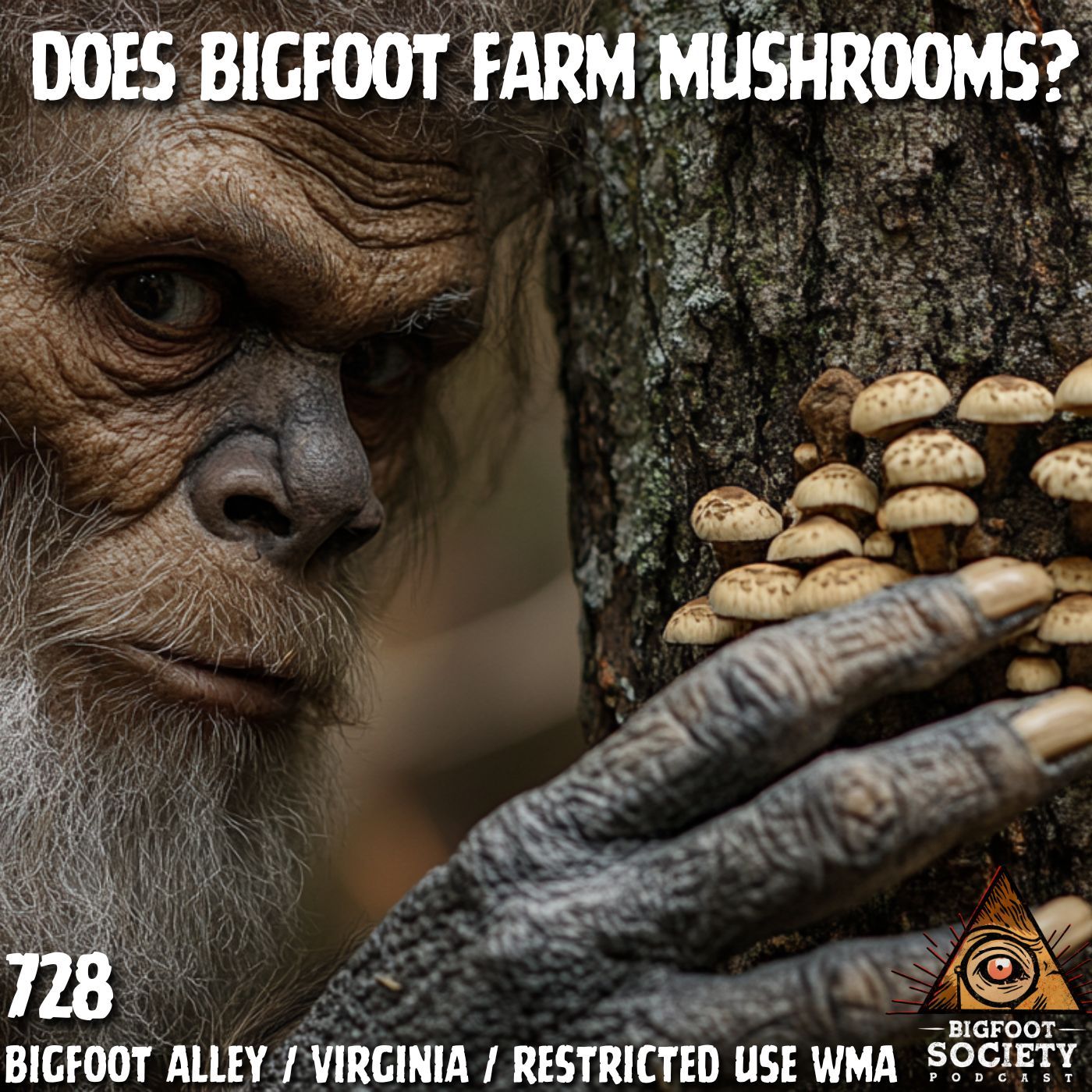
Join us on Bigfoot Society as we delve into the fascinating and eerie world of Bigfoot encounters with guest Anita Allen. Anita, an artist, writer, and seasoned researcher from Southwest Virginia, shares her thrilling experiences from Bigfoot Alley, a...

 Apple Podcasts
 Spotify
 Castro
 RSS Feed
 Join us on Bigfoot Society as we delve into the fascinating and eerie world of Bigfoot encounters with guest Anita Allen. Anita, an artist, writer, and seasoned researcher from Southwest Virginia, shares her thrilling experiences from Bigfoot Alley, a mysterious trail in a restricted wildlife management area. Discover her initial 2004 sighting, frequent trips, and the intriguing knocking patterns and possible fungal farming activities observed over the years. Anita also discusses the potential cognitive benefits of fungi for Bigfoot and explores profound theories on the existence of these elusive creatures. Don't miss out on this engrossing episode filled with firsthand accounts, detailed observations, and a fresh perspective on Bigfoot research.
Sasquatch Summerfest this year, is July 11th through the 12th, 2025. It's going to be fantastic. Listeners, if you're going to go, you can get a two day ticket for the cost of one. If you use the code "BFS" like Bigfoot society and it'll get you some off your cost.
Priscilla was a nice enough to provide that for my listeners. So there you go. I look forward to seeing you there. So make sure you head over to www. sasquatchsummerfest. com and pick up your tickets today.
If you've had similar encounters or experiences, please reach out to bigfootsociety@gmail.com. Your story could be the next one we feature!
🔴 Subscribe to our Youtube channel and leave a comment here: https://www.youtube.com/@BigfootSociety?sub_confirmation=1
Want to call in and leave a voicemail of your encounters for the podcast - Check this out here - https://www.speakpipe.com/bigfootsociety
(Use multiple voice mails if needed!)
Share this video with a friend: https://www.youtube.com/watch?v=z5v75Od-X38
Watch more episodes of the Bigfoot Society podcast here – https://youtube.com/playlist?list=PL3t1vwtsKh-MGeHs0XglFJE5LwUHpmJm_&feature=shared
Recommended Playlist – New Jersey Bigfoot Encounters - https://www.youtube.com/playlist?list=PL3t1vwtsKh-Mk4032IyZtWgP6LVPU8uat
✅ Help me help others share their Bigfoot Encounter by joining the community on Patreon - https://www.patreon.com/thebigfootsociety
✅ Hear ad-free episodes early by joining the community on Youtube - https://www.youtube.com/channel/UC8Qq45W6iaTU8FE9kelxT7Q/join
Let’s connect:
Instagram – https://www.instagram.com/bigfootsociety/
Twitter – https://twitter.com/bigfoot_society
Tiktok - https://www.tiktok.com/@bigfoot.society
Support Bigfoot Society by checking out these businesses and products we use below:
Beam (better sleep)
https://share.shopbeam.com/hnpc4ype
Wildgrain (better bread)
0:00 Welcome to big for Society. If you have Bigfoot activity to report from the same areas discussed in this episode, please reach out to me directly after this episode. And if you'd like to be on the podcast to discuss a personal Bigfoot encounter, please reach out to me directly at Bigfoot Society at gmail dot com. Do you wish there was more big for Society to listen to you every week? Well there is now. If you become a supporting member over at Patreon, you get a special members only episode every single week on Wednesdays, and sometimes even more episodes. Head on over to Patreon dot com. Forward slash the Bigfoot Society and now let's get on with the show. At Bigfoot Society that the privilege of talking to Anita Allen today. Nita is an individual with a lot of really interesting things to share. We were just talking a little bit before the show, and it's going to be a fun one. Anita is an artist, writer, outdoorswoman, and fourteen phenomena researcher living down in Southwest Virginia. She's experienced a lot of really interesting things over the years, so glad to have her on the show today. Anita, how's it going.
1:08 Hey, oh, it's going fantastic. Is there anything else that we should know about you before we get headed down this road? I wouldn't know where to begin. I jokingly say that I've led a very interesting life, but I have been experiencing fourteen phenomena for lack of a better word, since I was basically maybe a year old, and I grew up in a haunted house, learned to deal with all that stuff. My family is very, very, very science oriented.
1:48 My mother's response to any question of what is that is read a book, that the answer is in a book. And so I spent most of my early childlihood trying to research about the phenomena of the spirit that we lived with and everything else that was going on, and came to the realization that science didn't know everything yet, and my mother's response to that, or my grandfather, who was a naval scientist, his response was essentially, if science hasn't figured it out, then it's your job to go figure it out. So I decided to study parapsychology. It's not what I have my degree in, but that was my side hobby and study this phenomenon. And since I come to it from a naturalist point of view. I have a very passive way of doing it, where I spend long periods of time literally just studying what it's doing and taking notes and collecting data and trying to be as unbiased as possible about what I'm seeing, experiencing, or making notes on. Because the devil is in the details.
2:56 The truth of what we're seeking is going to turn out to be from something that everybody's overlooking because it's just too obvious to be a part of this phenomenon. But I really feel like it's going to be something like that, and we're all going to be slapping our heads and going, oh man, it was right in front of us. So I have a lot of notes, lots of pictures, lots of things that I get involved in. It's some really interesting stuff, and you've been sharing some photos and so I'll have those in the YouTube version as well. So if you listen to it early in the morning, you want to go over to YouTube and check it out over there as well, because there's going to be a lot of photos from Anita. But Anita, you're on the podcast specifically to share some really interesting things that happened to you. I leave back in two thousand and four, Would you mind taking us back to that time to share what you experienced more concerning bigfoot?
3:58 Certainly, So I got involved with the Virginia Blue Ridge Bigfoot Research Organization kind of by accident. I had returned to college and was finishing a horticulture degree, and I had a lot of downtime, so of course I was doing my paranormal research and found that there was actually bigfoot research happening in the Blue Ridge, and I had friends that had had experiences. So I went to the site and conveyed their experiences, and William Drangus, who was running the organization at the time, got in touch with me for more details. We ended up corresponding. He loved what I was doing degree wise, loved the research that I was bringing back for him. I had access to a primary folklore collection at the time and was able to really go into it and look for His specific request was pre colonial early settlement era reports on bigfoot, So that was my target that I was hunting, and I was having a great time doing it. So I was kind of doing a little bit of field work for him. His most of his area was northern Virginia and the Manassas area at the time, sometimes up around Chesapeake, and I was at least six hours away, so occasionally I would go up and do research on one of
5:29 the sites that he had in the Charlottesville area, and you know, did a lot of corresponding photographically. So I was. Out near a wildlife research area, and I'm going to be vague on this part, but it is a wildlife management and botanical research area and it's a restricted access, or at least it was during that time period. It is still strict use, but not as restricted now. And I happen to be in that area on business, which factors in that morning. So I had one of these new cutting edge miniature handheld video cameras way back in the day. This is two thousand and four. This is the March of two thousand and four. This was a Wednesday morning, about eight or nine o'clock, and I was going to test out this camera. So I am not dressed for hiking, but I know that this wildlife management area is fairly easy trails, very enjoyable, and it's got some unusual tree features. Today nobody understands why there's this weird bend at the bottom of a number of the trees, it's like they came up. They come up a few inches and get bent over, and it's not the same as the right angle tree markers. The assumption is that
7:01 at some point in time in the fifties there might have been some kind of strange weather event or something that forced all these trees over. They're not in a line, they're randomly up and down one particular hillside. That particular hillside is an area that I call Bigfoot Alley, and we'll get into that in a minute. So my thought was I was going to go out there with the camera, have some fun, film some of this, send it back to William and get familiar with the equipment. And so I am dressed for business. I'm not skinny, two hundred and sixty some pounds. I'm a chunky little monkey. I was wearing brown kitten heeled boots, brown pants, a white sweater, a long brown leather and shirling lined coat, and a brown leather cap leather hat. And I have bright white blonde hair, just to give you the idea. So I accidentally was Bigfoot colored. I think this may factor in.
8:08 I'm not sure. Well, I've noted that whenever I am in earth tones, there's more activity, so I'm not dressed for this. I go out. We have had nothing but horrible ice and snow, just like this past year. Off and on we'll have a warm up and then a freeze, warm up and a freeze, so ice has become packed. And when I get into the area, initially the weather's lovely. It's about forty degrees in the lower sections, perfect for going for a winter hike. And I go and hit the trail. I don't notice anything at this point because I'm not looking for anything and it's just a normal winter hike for me. Now, when you get through Bigfoot Alley, there's this switchback that goes is up to a ridge.
9:03 On top of the ridge, the trails are basically a figure eight. You're going to come in at the middle part of the right side of the figure eight, and going to the right, you're heading more northeast. Going to the south you're going to be heading or going to the left you're going to be heading southwest. And about where the meeting point is in the center of the figure eight is a narrow pathway where you climb down some rocks down into a wildlife management area. Again restricted use. No chance of they're being bigfoot here. It's far too close to residential areas. To the far side it is all pastures and cattle farms butting up on the community.
9:56 The ridge itself used to be part of a pasture until the nineteen fifties when it got turned into this research area. There were stone piles along the edge of a bluff and out of California at that time was coming a lot of interesting research and reports of bigfoots using those stone piles as places where they would hunt the rock squirrels, the little ground squirrels that lived there, and that ties in with my own stories of them rabbit hunting in the region, and I thought, well, that'd be a cool thing to take pictures of, so I was looking to do that. So I hiked up the switch back and took off to the right into the denser, icier areas. Because up on the top it had not thought to get to the rock piles and take some pictures.
10:48 There are no tracks where I'm at. Initially there were some deer in turkey, and some fox and a couple of raccoons, the normal things that you see up there, but there was no larger creature tracks, and so I was breaking the ice, and I got maybe a half mile before it became impossible to go forward. I was literally taking the heel of my boots and hitting with as much strength as I could to crack the ice to create something safe to step on, and I couldn't do it. I got to the point where it was impossible, and so I shot a little bit of a video there and I said, William, if my two hundred and sixty five pound backs I cannot break this ice, I can't go forward, and I'm not too concerned about what's beyond here. I'm going to head back. And so then I hiked right back down the trail and I thought, well, let's go down to the wildlife management area. That'll be fine.
11:41 Haven't been down there before. It'll be nice to rattle around there. So I started going southward. That was a big mistake. Very quickly I discovered that our clay and loam soil was frozen about two inches underneath. So I had two inches of sticky, slippery, disgusting, slobbery mess on a downhill on top of ice. So I got about as far as the trail juncture and was like, oh, I can't do this either. So I decided to head home and I started hiking back up to and as I was coming up to the trailhead, I noticed often the distance that I could hear ice crunching, like maybe something had fallen. I heard a crunch, crunch, crunch, and I thought, oh, okay, somebody else must be up here, and so I started looking around. I can't see anything.
12:44 Understand that everything is packed down with ice and snow, and there are a few pine trees, but for the most part, I've got a clear field of view. So I'm figuring maybe the sound is coming from down somewhere below, and so I'm turning around. I'm trying to orient my hearing. It is one hundred percent coming from north of me. It is on the more left side of the ridge from me, and that is where the opposite side of the trail comes down. But it's not as far down as that trail. It's I mean, I didn't know at the time. I hadn't been down that trail, but I thought it was coming down that particular trail maybe at this point five hundred yards roughly. And so I continued walking forward, listening, trying to see the person that I figured was maybe snowshilling up there, which I thought was weird.
13:45 But there there is a ranger station nearby, and it could have been a ranger out doing a walk through. You know, there's a million different reasons why another person could be there. But I get all the way up to the trailhead and I should be able to see this person by now. They have to be within about fifty yards of me, and I'm still hearing them crunch, crunch, crunch, slowly coming closer. They're not there. I don't see them. I don't know what's going on. I'm figuring this is the best camouflage. Ever big for society, who will be right back after these messages.
14:41 So I stand there listening to this, and I quietly turn my camera back on and I put it up on my shoulder, very slowly sink down into a crouch, and as I'm recording this, I very quietly whisper, William, I don't know if you can hear this, but something is walking towards me and I can't see it, and it takes a couple more steps and stops. Now at this point, I have a direct line of sight to that sound. I know where it's coming from It is literally, well, you can't see where my car is from this window, but it is with an eyeshot of me, I can absolutely get a bull's eye on it with my arrow.
15:25 I know where this is. I can hit it with a rock. I can't see it, and I'm like, what in the heck is in front of me? At which point on my left, in some brush of some dried up cane, I hear something make this weird cough sound. It goes and I look at it, like what the heck and I'm looking for a gray fox or something. When something responds from a dead fall on the other side of the meadow up ahead of me, and this is about thirty feet to my right and goes, and I'm like, nope, I'm done. I'm flanked. And I said, I'm flanked. I'm out of here. I stood up quickly, spun the camera around so it was recording my back and I took off down the switchback, and I was like, Okay, I'm definitely coming back to figure this out, but today is not the day. I sent the tape to William After reviewing it. You know, you could hear something, but in the entirety of it you can see nothing. There's nothing on that tape. He didn't see anything either, so he said just keep him posted on it. And this was outside of his comfort area because, like me, he believed these were flesh and blood creatures, So how does it not be in front of me. I still believe it's fresh and blood. I just think that there's more to it than we're giving it credit for. But that started a regular visitation to that location for the next
16:56 five or six years, and I would go at least twice week. Then after that gas price is shot up. It's a fairly long trip from where I live, so for me it became easier to go maybe once a month or a couple times a year. A few years before COVID, I was only going again a couple times a year. From the COVID I did not go, and then I started going basically I think in two actually it was COVID around twenty twenty one, I started going once a year or you know. At this point, I'm about three or four times a year. I'm planning on going a lot more this year, and I've already been up a couple of times this year. I'm probably going to go next weekend if I don't go tomorrow. But the interesting thing that I have learned from this, and I've seen this with other researchers as well, is some of this stick art that I see in Bigfoot Alley is identical to stick art that's coming out of the Carolinas, Tennessee, Northern Virginia, Ohio. Just it's identical. And if this is random branches falling, how do they fall in the exact
18:26 same pattern over and over again in so many different places. You know, my area, the Ridgetop had a wildfire several years ago. It did minimal damage, but I did notice when I started going back more regularly that the behavior is very different now. Pre COVID, there could be a regular interactions with some of them. I wouldn't see them, but they would knock pattern or one of them would knock patterns with me. But post COVID, that doesn't happen.
19:09 During the COVID years, they allowed the area to be used for people that are interested in exercise, so we have a lot of trail runners that go out there. It is almost impossible to go out there now and not encounter a trail runner. And these stick figures in the woods are much smaller now. They're not made with as large a branch or a tree. They're made lighter weight and more open. And I tell my friends, I think it's like they're whispering. They're still there. They're still in the same areas. So the weird asterisk design instead of being made out of full trees and wedged between a couple of trees in this spot and this spot is made with small branches and it's lower to the ground, and it's made also in that scene area the same quadrants.
20:02 And I don't know what it means, but it's still there. Anyway, I've rattled on me, give me some questions. Ask me someone absolutely it man, some weird start the beginning here. Yeah, I know this is just the beginning. So can you tell me more about you mentioned uh knocking patterns and that you were back and forth. Yeah, can you share a little bit about that. Okay, So Knocker, I don't know if Knocker is still out there or not. I think Knocker's female. I don't know why I get that impression, but I refer to Knocker as a herb. Okay, so Knocker is interesting. When you go up Big Fidale right before the switchback to get up on the bluff, you make a sharp write and start the switchbacks. So at that point I would often stop, you know, just for a moment to listen.
21:01 It's very important if you're spending time in the woods to spend time and listen because the things that live in the wood will tell you everything. They will tell you everything that's going on. Blue jays are your best friends. So I often will stop at familiar spots just for orientation and to listen. And so this particular spot, you know, it's kind of secluded, there's not much happening there. There's a few big boulders. So I decided one day I was going to take one of these rocks and I was going to try to do tree knocking. Because when I tried whacking the trees, it doesn't make a lot of sound, doesn't sound right. And try the rocks. And when I say it doesn't sound right, it's because the bigfoot knock sound. Sometimes it sounds like they're using branches and trees. Sometimes it sounds exactly the same, like maybe they're doing a lip pop or clicking their tongue on the roof of their mouth or something. Because it's the same sound. So I started with this thing where I would knock and off in the distance, like I can't remember if at first it was like this or not, but I would knock and I would get a response.
22:25 And this later became such a regular thing to do it from this spot and get a response from something, that this something, which I call knocker, would actually start responding wherever it was that it hurt it and would respond like I would tap tap, tap and it would knock, knock, knock, And then I would tap tap tap and it would knock, knock, knock from closer, and I could tell where it was coming from. And it was that quickly that we were responding until it was within, you know, fifty yards of me, and it was always where I couldn't see it behind some brush, and it drove me crazy because it would get so tantalizingly close, and I felt like I was breaking protocol if I left my position and went down to where it was at. I wanted to, but I did not want to scare this thing. I wanted it to make the first move, And so that's the spot that I will leave treats at or whatever. But it started out with just the little knock, knock, knock, and then a random response. Then it started with the knocking getting closer when it was responding. And as I've just said, it will come from a distance. Normally it comes from an area that is in a wildlife management property. I mean, this whole thing is restricted. You can't hunt here, you can't collect plants here, you can't take up the rocks here, and that's why there's rangers in the area. It really
23:55 is restricted use. So this isn't a person, and it could move at least once. I was certain that the location that it was knocking a response to me from started a half a mile away. It covered that area in about thirty seconds to respond to me close up. And it had done that from distances often enough that I know this thing was fast. This was happening anywhere from seven or eight o'clock in the morning until six or seven even eight o'clock at night. You can't be in this location after sundown. That's another restriction. So I was having daylight, regular encounters any day of the week, anytime of the week, I could get knock or to come.
24:48 At one point in time, there were some researchers from the New River Valley group that I was talking to, they came and joined, so it was me and four other people and they were having the time their life because Knocker came. And Knocker was very quiet when it got with in visual range of our group because obviously there's four people. That's not what it's expecting. So I made it a point to, you know, put my hand on every person that was there and hand them a bottle of water, which to me was a way of saying, I'm taking care of these people. And then when I would do my taps, it would tap back, but it was hesitant at first, and at first it didn't want to tap a response to the people, you know, the other guy when he was tapping, but then it started responding to him, and he just was losing it because it was responding and he wanted to run down there, and of course he did try to go down there at one point and it stopped responding. So it was like, okay, well that's the end of the fun today. But basically the game that we would play, I started knocking patterns like tap tap tap or tap tap tap tap tap tap, and it would respond with them, though it would take longer gaps between the responses. I found that anything over three or sorry, anything over four taps three, you know, three times, it couldn't follow it. So like, if I did tap tap tap tap tap, tap tap tap tap,
26:21 it could follow it. If I did tap tap tap tap tap tap tap tap tap tap tap tap, it could only do the three. If I did tap tap tap tap, it could only respond tap tap tap. And it's like, I don't know why. I don't know why that four was the cutting off point, but that was where we went, so I don't think they can go beyond four. Sorry, I'm trying to rush my thoughts here on it. But we did that for many years until I stopped going up there. I was having a lot of health comps cations, and again the cost was getting exorbitant.
27:04 William was caught up with some of the stuff that he was doing in he know, I just really didn't have anybody to share this with, and so I was like, well, I'll just keep my notes and I'll keep visiting off and on. And I have not encountered knockers since I've been back, but you know, I'm trying. I still go down there. I still knock and I'm hopeful that maybe at some point she turns back up between the fire and the fact that there's eighty million people showing up. Now, she may not be as willing to come and respond. But you know, that was kind of fun, and I hope that I'll be able to start doing that again at some point.
27:52 It's always fascinating when you have interactions back and forth, and that's a great example of that. What first made you think that whatever you know, you're you're interacting with Knocker. Was there something that made you think that Knocker was a female? No, I have no idea why I get that feeling. I've learned to trust my instincts. That's part of my growing up with a ghost in the house. I've learned to trust that. And I feel like that's the female and the ones the little rock chuckers up on the top that irritate the daylights out of me. They're they're up on the ridge. I tend to think of those as juvenile males because they behave like juvenile men. Sorry I hate to say it, but it's true. These guys.
28:46 You'll be down on Bigfoot Alley and they'll be tossing rocks down at you, and the whole point of it, I think, is to make you look. They're not trying to drive you away. I think they're like, it's their equivalent of going, hey, hey, look over here. Hey, because it's little rocks. I mean, that's not scary. If they wanted to scare me, they throw a big rock, they wanted to scare me, they'd make a threat display. There's absolutely no threatening vibe on this. There's no reason for rocks to randomly be coming off of that bluff and landing, you know, in the leaves on the way towards me and always within range of me. That doesn't make any sense whatsoever unless there is something up there that is happily just tossing peanuts. So you know, I think of those as being the boys, right, being obnoxious little teenagers, and I will pick up rocks and throw them back at them. Hey you do, And I'll keep doing whatever it is I'm doing.
29:47 Big for society who will be right back after these messages. Because you know, it's like, yes, you're annoying, here's a rock, Now go play with your brother. And what I'm doing, of course, is as I told you, I'm I'm observing things like the way that they're bending these trees and what appears to be rudimentary mushroom farming that's going on right now. You know, I also see where they've hollowed pathways or something. I can't say it's one hundred percent them, but something has carved large, wide pathways underneath the You might call it greenbriar or catbriar, but it's a smilex.
30:44 It's a very nasty, thorny plant, gorgeous vines, heavy thorns, natural bob wire. The stuff is edible. It was part of my survival training growing up. And the berries get sweeter after the winter when it starts to get nice and cold. But they're very popular with birds. They're a good winter forage. They're not something I'm going to go charge in there to collect and eat. You know, people talk about rose hips being a great winter food. Rose hips can be, but by January they're a slimy mess, and most of what you get is the nasty, sharp little fibers that are in there. So rose hips, in my opinion, are more hassle than they are to eat.
31:39 But I don't know what a bigfoot's mouth's like, so I can't really tell you whether or not that's a problem. It is an edible, it is calories. And when you research big foot, you have to remember that it's not going to go to McDonald's. That they will eat things that we normally would go eat. God no, And you know we've heard plenty of stories of them eating carcasses. I know of their hunting technique from research to be an ambush predator. So they will stay perfectly still, low to the ground, very comfortable, until what they're looking for moves near them, and then they'll snatch it. And that tends to be rabbits, squirrels. It explains why I have found piled up tiny berries on rocks. That was one thing I could never figure out. In one of the sites that I went to for William was a boatload of sorry, I had to find the common name blackgum tree nessa slovetica. I was finding the salvettica berries on top of a rock in a pile, and nothing this side of the Mississippi does that pack will do something similar, but they're not going to leave them in a pile out in the open. And yet on this site that I was researching, there was a pile and it was
33:11 near some rhododendron, and having seen this in other places now I'm like, huh, that would make sense if you're trying to catch a squirrel, a rabbit or birds, because if you were nearby and camouflage, say under the leaves or underneath the smile x, or you know, a host of other different ways blended into your environment. You have to understand these guys are in a natural Gillie suit, so they're constantly camouflage. It would be a perfect thing to do was to leave this in an open location. Something lands to eat it, and you can just snatch it and stuff it in your mouth, so whole bird goes right up in there. That makes sense to me, makes perfect sense when you think about it. The predilection for my guys for hanging out on a bluff makes perfect sense too, because they would use it like a chug water run the game that's a rock structure out west as a ramp on one side and a bluff on the other like a cliff. You basically run things off of the pastures up on the top off the edge.
34:22 The deer will jump and then break their legs when they land. Halfway between the bluff and Bigfoot alley and then you just go pick up the deer and eat it. So it fits with hunting technique. So I'm like, okay, okay, this makes sense. And these carved out areas underneath the brier, you can sit there. Nobody's going to see you in the summertime because it's so incredibly dense. It's a green wall. You can just lay down there, because I think they spend a lot more time moving on all fours than upright. It's more calorie efficient to move on all fours, and I think they're under there. I think they're happily eating the leaves and the shoots, which are the sweet parts, so parts that I collect and eat, getting the berries when they want to, waiting for the birds to come into the tangle to get the berries, and grabbing a bird, you know, pop a little bow jangles right up in there and they're fine, so it's easy eats. So that's what I think is going on in some of these areas, and so I'm documenting those and I'm watching them. I'm planning when the weather gets a little bit warmer to start going down into these little tunnels and looking seeing if I can find hairs, because if they're going to get hairs anywhere. It's going to be caught in those briers, and so my goal this year is some hair collecting.
35:46 That's awesome. I think that's a great way to take the research forward, or to attempt to have you talked to any of the rangers in this area about any of your research over the years. Are similar things. No, No, that's kind of one of those things where you don't want to be like, that's the field that I overlap with and one that I will occasionally work with and one that I wanted to get on with in my younger years, and you kind of don't want to weird your potential employer out completely. So it's not something that I commonly discuss with them. Folks that i'm friends with i'll talk to, but no locally with the rangers.
36:34 You know, I'm in my fifties, so a lot of the people that I know have passed, and I don't really know too many of the new guys. But you know, if I run across them, I'll probably grill them because I'm weird that way, and I've decided at my age, I don't care who knows exactly. I can totally understand that have there been any reported or maybe just you've heard visual sightings in this area of bigfoot. Yes, yes, some of the reports that came in on the Vabro site were in that area. I'm not going to name it because I don't want problems. And I come from the era when there was a very very very very large bounty on alive well not a live, but a dead bigfoot, and it became a big thing to try to hunt a big foot, a bigfoot and kill it. So William was having regular problems with people figuring out where sites were and cruising them. There were problems with people with guns in the woods. I like to be able to hike where I'm at and not be afraid of some idiot with a gun. I also don't want to be followed, so for me, having a peaceful time in the woods means I keep my areas quiet.
37:55 But yeah, these there have been documented reports on regular websites about sightings within five or ten miles of this location. And the sighting one of them that. Was the closest that someone was very upset because there was something that was huge. It had they'd figured out it was at least eight feet tall. It looked like a person. It was coming to the wood edge about a half an acre away or sorry, about an acre away from her house on their property, and it was just standing at the wood edge and kind of bobbing back and forth slowly watching them. And her boyfriend had gone out a couple times and shot at it, and they didn't know what it was, and they were having quite the freak out over it, and then it just stopped.
38:56 You know, it'll do it for like a couple weeks at a time, and then it stops. There have been within an hour of that location, there have been hundreds of reports. I mean we got I am two hours away from Norton, which is it's got a big foot wildlife reserve, you know said wildlife sanctuary for bigfoot. Where the job that I worked, which is a forty five minute drive, I had a lady who gave me, without even asking about it, told me about the wood booger that would come and knock on our house. A lot of folks will call them wood boogers in that area.
39:41 Closer to me in Bedford, which overlaps part of that area, we have a lot of reports. We have some scary reports that come out of Bedford. The report that I had given William initially is only thirty minutes from the site. So so you know, we have plenty of reports in this area. It's just this is the East Coast, and even though we now have an East Coast Bigfoot Society and everything else, people just don't want to acknowledge that it's here. And I mean, I understand why. I understand legally why they don't want to acknowledge its existence. It's the same reason they don't want to acknowledge the existence of relic populations of wolves and small populations of cougars that are in the area. You know, it's because it changes the land use and you end up with new regulations and it steeply affects how you can do businesses, housing and tourism. And so because of that, you really can't admit to the existence of something that has federal regulations on it until you have absolute, undeniable, irrefutable proof that it's there. And in the case of cougars, the mountain lions that we have, they don't want to admit it because of that, and the basically the population that's
41:12 being observed is not large enough to be considered a viable population. The inbreeding alone would take it out, so it's considered transient and not a concern. Same holds true for the few gray wolves that we have in a couple of locations. We now have such a large influx of Eastern coyote to the region, which is a domestic dog coyote and northern gray wolf hybrid, that what little population we have of wolf will probably be completely consumed in the gray in the eastern coyote population within the next twenty years. There's not enough left to stay to keep it, you know, cure and sustainable. So even though we've got bigfoot here, a lot of researchers have been reluctant to admit it because it's too far away, even though we have historical pre settlement area or era recordings of them. They're like, no, no, no, that can't be real.
42:21 And yeah, they're here, they're here, And most folks just call them, you know, a wood booger or a hairy person and ignore it because you know why, it's just an airy person. It makes it, uh, maybe a little bit nicer to try to understand in your mind. I guess if you were to say that, I mean that's Virginia does have some really wild stuff in it. It doesn't come up a lot on the show, but I'm glad when it when it does. This area that you've been focusing on we've talked about, Knox. Are there any times when you've noticed what could be considered like mimicked noises anything like that.
43:09 The closest thing to a vocalization that I have heard in mimicry was the last when I decided that it was going to be my last for about for a while. And this was back in the twenty teens, probably around twenty either twenty oh nine or twenty eleven. I sat up there and for about an hour I played my flute. I have a Native American flute, and I just played. And when I stopped playing, something made a sound about I don't know. They were fairly close to me. I was sitting up at the juncture between the upper and lower trails, right above the wildlife area. So I was sitting on the rocks playing and this was from down below me in the woods and down where I couldn't see, so maybe thirty to forty feet and it just kind of made this sound, and I was like, what in the heck because it wasn't a tree. You know, the wind wasn't blowing. It was a beautiful summer day, and that's not a normal animal noise. But as far as mimicking me, I'm not out there talking, so you know,
44:41 I'm not whistling. I'm not doing any of the things that normally elicit responses. As far as people, most of the people that I see up there are jogging, so they're not whistling, talking or doing whatever. When I go up there with a couple of my friends and we're talking, I have not heard anything. Big for society who will be right back after these messages.
45:22 Mimicking us. So I've not had that experience there. I'm not saying that they don't, because I'm darn sure they do. Mary Green was a friend of mine for many years. She was a hardcore researcher, and she talked about not only the mimicry, but their ability to use language, and a chunk of research coming out of the Pacific Northwest in settlement era involved the Bigfoot using one of the trade languages, and you know, some very interesting encounters involving Bigfoot and trade language. So they can learn it and they can mimic it. I don't know why everybody is so hardcore that they can't. I mean, I had known cats that have mimicked people. If you've ever had a husky, you know they will mimic people. They don't have the vocal structure to mimic a human. Dolphins will do it.
46:29 They don't have the vocal structure, you know, parrots and all the rest of them. Nonwithstanding, if all these other animals can find a way to do it, why are we biased to say that a bigfoot cannot. We've got documentation that says they do. It means you have to spend time with them. It means you have to try to teach them the language or they have to hear it regularly, but they'll learn it. So yeah, I haven't experienced it myself, but I have no doubt that it is perfectly possible and perfectly within the range of their abilities. No, I mean, I agree with you. I don't see why people is like, that's the hill I'm going to die on, is that they can't have language, because dude, it's being captured right now in Oregon. Like I am involved with an area where it has been captured multiple times outside of Oakridge. It's like it's not crazy, like it is not. I don't think it's crazy to go down that road, but.
47:33 Right, I mean the one the report that I'm most fond of that was out of the Pacific Northwest. This uh trapper trapp or trader thought that, you know, he saw this human, a little native boy and a bigfoot traveling together all the time and doing stuff, and when he would come around, it would hide the boy inside a tree, and so he managed to lead it off one time have it follow him and went back to rescue the boy, and the kid, you know, was only speaking I guess his native language. I think it was clean cat, but I'm not sure. And he grabbed the kid and got him in the boat because the bigfoot out there don't swim. They tend to bob, and so he got out in the water with it on the boat and was hauling the kid away, and the bigfoot came to the shore and was screaming at him in trade language and was yelling at him, return my friend, give me my friend. Where is my friend? And was yelling for his friend, and the boy kept trying to go back to him until he hauled the kid away, and he took the kid back with him to town to corroborate the story and the kid. I don't know if the bigfoot broke the kid out or the kid got away, but either way, that night, the kid got away from where he was being held, and so they assume they probably met back up. But I mean, it's
49:05 very clearly yelling at him in a trade language, so it understood that the guy in the boat didn't speak the language that the kid spoke, and the kid was willingly hanging out with this bigfoot and running around with it. So either it was raising the kid or it was, you know, just friends with the kid, but either way, it was protective of him, you know, and it was referring to him as my friend, give me my friend. So if it can learn to say that in a trade language and identify that the person in the boat speaks trade language, it's absolutely ridiculous to think that the others can't learn it. And Mary, when we used to be we had a Friends of Bigfoot group and we were online talking all this stuff all the time. Several of the people talked about people from our region and the Bigfoot language, and the Bigfoot language was written down and they shared it in I guess a book, but it immediately got discounted because it was Cherokee. And I'm thinking, oh, for the love of Pete Moss, where do we live in Cherokee Territory? What's the common language in this section Cherokee?
50:24 So why would they not be speaking Cherokee? Why would they not be using it? So I'm just you know, for me, I'm gobsmacked that they won't consider that data. And I understand why they don't. It's scary. It's terrifying to consider that there is something out there that chooses a simple life, chooses not to be a part of our society, chooses against modern everything, and isn't like us. I mean, we have this whole Uncanny Valley thing that we're terrified of where something that looks like us but isn't us is out there. And I mean that that's hardwired into us, from surviving to being the last known member of our species. You know, the other homos have all died out, you know, the Homo Devisonian's gone, the Homo Neanderthal's gone. We're it, so we think. But if there is a population of somebody that is, you know, in our family, in our branch of the family tree that is still out there. We're terrified of them. To think that they might be on part with us or superior in any way is simply too much for most people to conceive of. I mean, it's just too scary.
51:51 It's too much of a paradigm shift in thinking. And I'm perfectly happy thinking that this is a physical being that you know, has these abilities and so on. But when I'm up there on top of the bluff and i can't see it, it's like, woo, no paradigm shift. This is outside of what I thought. I'm going to have to accept that. I have to throw everything I know out and start from scratch. You're more than we think, and that's that's where my brain is. My brain is this is This is a greater mystery then we can conceive of, and we have to accept it.
52:34 It blows me away where at the end of the day, there's a portion of the community that this is going to just get me. Just go bring it on. I know where you're going. You're going to talk about the folks that will die on that hill. But here's the thing. It's like, Okay, we're in a subject such as bigfoot, and yet you're like not going to look at all the things that are being said, and you're like, no, I'll only go so far because dude, dude, just stop it. You know, like, come on, man, we're okay. When you're when you jump into the weird pond, you have to be willing to swim over all the weird pond.
53:17 Weird though, Like we're okay. Here's the thing. So like when we when we use that terminology, like I think it's I don't know if it's good or not. It's like I think we have to get to the point where we just accept that, like people are reporting stuff like it was invisible. It talked to me in my head. I couldn't move. Okay, it's it's it's happening, you. Know, like it is okay. So I mentioned to you earlier some of my friends that I run around with. My one of my favorites is Ron Lantham and Joe Purdue with Wild and Word West Virginia Radio. Okay, I've known them for several years now, and I you know there, I've done stuff with them. They're absolutely fantastic. Anybody that has anything weird to report. These are the guys that will take you seriously because they're science first. In that group running with them, what they do is classify these they're they're all sightings. Okay, these are all legit sightings.
54:25 If it is just flesh and blood and just doing the normal bigfoot thing, it's a subject A. If it has any aspect of the weird. There's a light, there's a mickry, there's a vocalization, there's a ufo, there's walking in and out of a portal, there's orbs. Any of that, that subject B and that is equally as relevant. And I can tell you a couple a couple of thoughts I have along those lines, because there's a researcher I was reading about the other day and it makes perfect sense. He's south of me. I don't remember if it's Carolina or Tennessee, but he says that every single time that you see a bigfoot, or you see an orb, or you see something up in front of you, that's like in one of those ooh ah, look at that turn around, there will be somebody behind you, there will be other bigfoots, there will be something happening. And I think that is one hundred percent dead on because Okay, this is going into the whole mechanics of the bigfoot and the physiology and morphology bigfoot, with its size and its mass and its calorie usage, it does not make sense that it walks around upright all time. It does not make sense that it goes flying through the woods all the time, you know, zooming and running around. No, that burns too much.
55:54 That's got to be a display. And to me, that's like a meerkat where you have that one cat guard that stands up and makes a noise so that the hawk will go for it while all the rest go to ground. I'm thinking that Patty in the Patterson film is doing that slow role as she walks by, so that everybody is looking at that bigfoot. Nobody's looking behind to see dad grabbing the baby and going into the bushes. You know, when Joe was talking about Joe Purdue was talking about his big foot encounter. He was hunting. He was up on a ridge and was looking right across at a family on another ridge. They were along a section that had recently been managed and cleared, and they were foraging, and they were down. They were on all fours in a crouch, just like any other gorilla urch in pansy and they were doing their little thing until the wind got caught and they might have picked up that he was out there, and it was real quick, grab the baby, go down and get out and get to the edge. And it was you know, one of them was kind of upright and watching, but not I don't think he described it as standing up. I think they stayed down the whole time. But he observed them foraging and they were crouched. The path that I'm seeing are down, they are low. They are the right position because a lot of times we sit down to eat.
57:21 Our bodies are just built this way. And for me as a as a field biologist or feel botanist, my job was to look at these areas and see is there enough forage to provide for a five thousand calorie a day diet. There has to be. If not, then the bigfoot is the sighting is treated as a transient sighting that it might be moving through the area or just foraging here and leaving. It's not living there. But if there's enough food for five thousand calories a day, then it's possible that it's a resident and this is a feeding area, and so My job is to look at it and see is there enough food here to either draw in animals that it will eat or two feet something that's going to use that much weight. Now I know for me, I actually have to eat a way lower calorie a day diet then somebody my size, even my ideal weight. Because of my metabolism, it's like so crazy slow, it's frightening. I'm a biological, freaking nature just right off the bat. I've got that blood type everybody talks about. I've got a lower body metabolism. I stay around ninety six when I'm running hot. My temperature drops when I'm sleeping. The lowest I've been clocked at night in the winter is eighty eight degrees, which is hypothermic.
58:45 But I'm fine. I think that bigfoot actually follow that, and that's why if they're at rest, they're not going to be showing up so easy on a thermal because their temperature drops as fast as mine does. And then when they're active, that's when they burn, and that's when you see them. I think they're a lot more cartilage than bone. I think that part of their chest is probably a cartilage plate, to be honest, just because of the stories from hunters, and if you wonder how that works, go down the rabbit hole of reading about a wombat's butt and just go for there. There there is biological what's the right word in this case, well anyway, there are other things biologically that if you apply it to the bigfoot, make what sounds like a mythological whatnot perfectly normal?
59:44 You know, like it's bulletproof. No, you can have really thick hide in cartilage and be dang near bulletproof. Yeah, so this whole thing, if cartilage explains why a bigfoot can go from being such a small baby to such a huge creature. Big for society will be right back after these messages. Because we know, you know, we go from small babies five to seven pounds to being huge and that has to do with cartilage and growth plates. But the more cartilage you have, the less bone you leave behind. If you die.
1:00:40 Oh, so where did your skeleton go? You see how it all CLIs? That's really cool. Where's the bones? How much cartilage was it? Was it a juvenile and died? You're not going to find boob kiss? Yeah, you know that's a really cool theory though. I like that. I'm gonna look more that. Yeah, this is what happens when somebody who's actually science minded, who grew up looking for the scientific explanation for something, drops into this field and goes, well, we're going to go to this direction. Now. You know, if I can't apply ape to this figure or only ape to this figure, what else is out there that can do this? And it's like, oh, okay, so what if it's chest area has the same structures to it as a wombat's that it you know, because this thing has to be able to handle fighting with a grizzly bear, because we have records of them doing it. So if they're going to fight with a bear, it's got to be able to handle those claws. I've had close up personal run ends with bears and that is no joke. Okay, we're not set for it. We are marshmallows to a bear, but we're making a huge, huge assumption that a bigfoot is a marshmallow to a bear. If that bigfoot's got rhino hyde, then you know, it's totally different. So yeah, it could
1:02:11 probably get shot at and be fine, be like oh yeah, that's a glancing blow. They seem to know how to treat it. There's plenty of records of them out west well in various places treating wounds. And you know, I think that we really have got to stop applying human, hairy human to Bigfoot, because that's not a hairy human. It's not a bonobo on growth hormones, it's not a gorilla, it's something else. It is in our family tree. We know that the whole thing with the similar DNA. Okay, I'm going to blow your mind on this one. So we know we have the whole We we have e DNA.
1:02:57 We have enough DNA off off off of Bigfoot. It's currently tested and being tested, but we have enough to know that it is some sort of old world ape DNA and human DNA. So everyone screams hybrid hybrid, hybrid, hybrid, hybrid, and I want to just do a three stew just slap across all of them. And the reason for that we share that our DNA with a lot of other animals and we don't interbreed with them. I would like to point out the common housecat. If you have to throw hybridizing completely out because your house cat, which is descended from the same line as tigers, Okay, that little house cat not only has some human DNA in it, it also has squid DNA. You want to explain to me the house part and drunken kegfest that resulted in that, because it's not inter breeding. It's some kind of lateral gene transference. But it's happening. And as far as with the bigfoot, we call it human DNA, but it may be what we've identified. We identify a one hundred percent of what's in our system as what makes us human, but other things share that DNA. Chimpanzees have that DNA,
1:04:31 we have that DNA, cats have that DNA. So why can't a bigfoot have that DNA? I don't think that you know. I mean, yes, I know because I've read the reports of human males and bigfoot females having relations. I don't know if it goes the other way. But one of the earliest reports pre settlement that I have from the Virginia areas involves the Outer Banks and a man and a bigfoot and an offspring that was produced. We have stories of the alma that was caught in I think her name was Zenya, but that was caught in Russia, and the people that have been tested that are her descendants have sub Saharan African DNA, so she may not have even been a you know, an alma.
1:05:24 But there's also the possibility of well, I would be giving you a DNA lecture, but essentially back crossing off of a mule to produce you know, either a donkey or a horse with some of the traits of the mule. You can do that. Mules are not one hundred percent sterile. You can back cross off of one of the parent breeds, and the same is true for pretty much anything. It's how we've gotten the American chestnut and the American elmback by back crossing. We found relic populations where they have gotten resistance to diseases, and we have gotten survivors that we have back crossed off of related species so that their DNA is one hundred percent say American chestnut, but it has the Asian chestnut resistance. There's no reason that some of these things we're not encountering aren't related. But I'm I'm jumping into like a two and a three hour discussion on DNA, and I don't want to do that.
1:06:33 It is really actually incredibly fascinating. We don't have a big foot in a box yet, so you have to think out of a box. You've got to be willing to look at the most absurd possibility. And it's like, Okay, how do I get from reality to the absurd possibility? How do I make that possible? Is there a bridge between here and there? And if you can't find a bridge, fine, get a bridge as far as you can and put a pin in it. Move on to the next theory because eventually, in time, it'll tell you whether that bridge loops back around and comes back to pint, to the starting point, or if it goes all the way to the weird. But you're just not there yet. You just have to wait that the science hasn't caught up yet. I'm hardcore onto all this.
1:07:18 Personally, this is a really good episode. I'm really enjoying it. But there is one section that I don't think will ever come up again, and so I want to make sure that we hit it here at the end sure or the last part of the episode. You mentioned really quick rudimentary mushroom farming, and I'm curious what that means. Yeah, okay, so I sent you a bunch of pictures. How would be the time to put them in the collage. Everybody, go to the YouTube page and please comment on it. So what is happening is in my research area, specifically in big Foot Alley and nowhere else that I've found in the area are there is a ridiculous amount of edible mushrooms to forage, and the trees are being bent.
1:08:18 Young trees are being bent at an angle that makes them less likely to shed water correctly and therefore more susceptible to fungal infection and to get basically mushrooms seated on them. And what I am finding is these particular trees tend to be bent at fun angles, they tend to be in the areas of the artwork, and the mushrooms on them are all edible. So I sent you a picture of one that is a member of the wood jelly family. It's woodier and it's on the way up on the switchback. But if this were something I could get away with in that area, I would be harvesting that for dinner. That's quite a delicious little mushroom there in the Bigfoot Alley section or at the other end of Bigfoot Alley, right, you have to go down into a ravine and then up. And the reason I started noticing the fungui was when I first started coming out there, there was a lot of achen called or a like in fungus hybrid. It's called wood or it's called rock tripe, and rock tripe is a survival food.
1:09:44 You use it to thicken soups. It looks like dried up, crusty algae on a rock, but it's not. It's actually a fun guy and it's usable. It's very gritty and not tasty. And I had noticed that people had basically climbed all over the rocks and removed it in this area, which may be very annoyed, because I liked it. It was pretty. Then I started finding in that area a mushroom called Lion's Main, and Lion's Maine currently is now being very sought after by a lot of foragers because it's very good for neurological issues. It's excellent, makes great fritters.
1:10:28 It's a delicious mushroom. And I sent you a picture of one of the trees where it has been partially harvested out of the tree, so you know that one there's that area has got a lot of the Lion's Man going in it. You cross the creek and go up into Bigfoot Alley, and that's where I start seeing the turkey tail and the wood ear being like, and also some of the shelf funk guy that are edible things like oyster mushrooms and stuff like that are being used. These are showing up on the artwork. The artwork is like where they have the arches. Specifically it's on the arches and it'll be the triangular shaped arch where you have a live tree that's bent over and it's either caught in a branch or another tree, usually dead, that's leaning in to create the upright section. Nine times out of ten it's a branch or an uprooted piece of tree.
1:11:39 And trust me, you can tell the difference between uprooted and something that's just been pulled over, because I'm looking at a base of all the little tree branches or trunk's roots sticking out. Sorry, and you know it's set on top of leaves. So it'll be this structure weighted down by more branches and the hanging branches will be seeded with or already growing mushrooms. That particular technique allows for rain water to slowly seat down the branches to increase the rot, which will increase the nutrients to the mushroom and therefore give you a larger, better mushroom bloom.
1:12:25 It also prevents the wind from blowing as much, so the mushrooms will stay at peak longer, and it will create a more humid environment because it's all this wet wood hanging around it. That will also encourage larger, better mushroom growth more frequent, and it will trap the spores in that area. So the unseated wood will then become seated and you can start a new colony somewhere else, just like you know, creating sour dough bread. So you have the branches that are bent flat that are getting the wood ear put on them. You have the shelf and brackets that are being hung in the triangle shape art pieces, and then there are upright sections of wood.
1:13:13 They look like stobs of tree. I have not checked to see whether or not they are trees that have been broken off or if they are actual trees that have been shoved down into the soil, but they are trees where This is something that I talked with my friend, one of my friends who's Native American, and I showed him some of the pictures of a vernal pool that I was watching because vernal pools are a food source. And I said, and I'm very curious about what's going on with this tree here. It's an old stop and it doesn't look right. And he goes, well, yeah, you've got the leaves packed all over the top of it. I said, yeah, that doesn't make any sense because the wind would have blown them. I don't know why they're there.
1:13:56 And he goes, well, that's how you get the mushrooms to grow. And I'm like, boo, that's exactly how you get the mushrooms to grow. And he goes, yeah, the natives did that all the time. And I'm like okay, And me, having studied mycology, was never taught this particular technique. I was never taught any of these techniques. I am a hardcore forager and I love, you know, survival stuff. My hobby is going out into the woods collecting edible plants, bringing them back and working them in is landscaping at my house. So people are always like, oh, what a beautiful plant. I'm like, yeah, and it's edible. You know. I do this for fun, So I don't know these techniques.
1:14:37 But I sent you the picture of the one of the tree that is I honestly think it's inverted. I think it's top down, but again I haven't sat down with it and studied it. But that is turkey tail that's flushing that little orange on it is all turkey tail being flushed up it. And you can see where the leaves are packed onto the rough parts of the broken section, and they're going to trap moisture. They're going to create extra dripping coming down, which means extra spray, which will encourage moss and it will encourage more fungi, and it will keep the area humid and moist and so it's better for.
1:15:17 Production, big for society. Will be right back after these messages. People are not doing that that trees or that stop that you're looking at as twelve feet. That's not done by a person. So what's doing it. If you look in some of the photographs, look high thirty feet up twenty to thirty and you will see right angle trees and over and over again, these look like the markings, the marking trees the natives did. But those are generally low to the ground, they're about waist high. These are up, so the tree was up before it was its growth was affected, and it was bent at a right angle and then allowed to continue upwards. That right angle is what mushrooms are being grown on. And I'm like, what the heck? And this only happens in Bigfoot Alley. I have been all over this entire preserve and I have been backpacking these mountains since I was thirteen years old, and I do not see this like this elsewhere, certainly
1:16:48 not with the frequency. If I go in Bigfoot Alley, I can easily Bigfoot Alley is not It's maybe a mile long. Okay, in that mile, I can point to you at least a dozen of those right angle breaks twenty feet up in trees of different ages. The tree is bent in a way that will not kill the tree, and it is allowed to go upright after about five to six feet. This happens over and over and over again, and I can't figure out what they're marking that high.
1:17:29 You know, you can really only see it in the wintertime. What is it for? What are they pointing towards? Unless they're climbing up the tree and eating mushrooms. And from what I've read, the juveniles do that I am. So glad that we had this part of the conversation. So hypothetically, so I'm out of my league in this part a lot. But so humans use Lion's Main to help with neurological improved, neurological. Correct type things, now cognitive functions. Right, thank you. So hypothetically, if a creature like a Bigfoot started ingesting a lot of this, could this potentially help their cognitive as well?
1:18:20 If their brain structure is neurologically the same as ours, then yes. And if Bigfoot is able to communicate telepathically, I would hazard a guess that yes, its structure is the same. So theoretically yes, it will improve Turkey Tale and Lion's Main and everything else along those lines also work in our pets. The doctor to follow The person to follow is doctor Statements. He has a line called Fungi perfect I. You can find him online. The CDC uses his research. Okay, this is a micologist of just extraordinary proportions. And you know, my professor was one of the tops in the field still is as far as I'm concerned, even though he's retired. He identified two different types of fungi on his own. The man has forgotten more than most people will ever know in mycology. And he turned around and said, this is the man to follow, And oh my god, he's right. Doctor Stamens is self trained, but he holds a legit doctorate now at this point for what he's done, and he makes stuff that is just I'm turning into an ad form. I cannot recommend
1:19:50 it enough. If you are interested in the effects of fung guy on the human body, on the animal body, on anything, read about this guy. He can. I mean, we know that we can use fungi to correct a majority of the environmental damages that we're doing. That. There are fungi that feed on radiation. There are fungi that feed on petroleum and petroleum by products. There is fung guy that will break down and destroy polycarbonates and vinyl and you know, all the stuff that we are having problems within the environment, we have fungi that came to remove it. The problem is that if we produce it in quantities large enough to solve the problem, we will destroy all of it that we use for day to day living. So right now it's being done in very controlled quantities to prevent basically complete destruction of the world as we know it by removing every type of petroleum byproduct by e plastic that we use, you know, plastic, vinyl, every polyfabric that you know. We could destroy them in a year completely if we release the stuff in the environment, But in the same time, we would destroy everything we are dependent on. So until we have a way to do this in a controlled function, we can't do much
1:21:21 more than heal the environment with a handful of mushrooms. And you know, if you want to follow that kind of story, if you want to find what you need to detox your system, if you want to find what you need to help your immune system to fight viruses and bacteria and everything else, follow doctor statements. I will not bore you with that lecture. But the man knows what he's talking about. You can trust everything that comes out of what he does. And yes, that's the go to if you want to look at are these guys eating stuff to detox themselves from eating our garbage or living in our bad locations? Yeah, that makes sense, that could quite possibly be doing that. We have seen orangutang use herbs and make pastes as medicine and treat themselves.
1:22:14 We have stories of bigfoots soaking themselves in water tanks to deal with gunshot wound infections and heal themselves. We have deer, We have stories of deer our everyday. Dumb forest goats, we have stories of them laying down in mud to essentially occlude wounds and you know, to cover up a wound and to heal it. And hunters will tell you multiple times of deers that have got antler wounds from others, from fighting with other deers that have insisted fur. You know, it basically impacted fur in them that they have healed up from. They know what to do it, just like dogs know how to eat grass to make themselves puke. They know what to do. There's no reason at all except for hubris that prevents us from thinking that a bigfoot can't do the same thing.
1:23:12 That can't eat turkey tail mushroom to help fight off cancer and to help them to adapt to living closer to humans easier. That can't eat this fung guy to help clear their head and think better. I mean, I don't think they would even consider it, honestly, if they were stupid. I'm sorry I'm saying this is wrong, But if you're if they're dumbed down, normal animal, and start eating something that makes them think better, then they'll naturally think better, and then they'll learn to associate this makes me think better and eat it. But if they are just an animal, they're just going to see that as food sure, and all they're going to figure out is food make me feel better. I eat more food to feel better, right, And then later they start to think clear and go, this food makes me think better, can actually contemplate the stars, so I will eat more and think about the stars. So they have they have to evolve up from that is food I eat food to that is good food. I eat good food for good things because our ancestors learned you eat that weird plant and you see things. I don't want to know which one of our ancestors was the one I learned this.
1:24:26 I learned this from my mycology professor. I don't want to know which one of our ancestors was the one that figured out that everybody else except for the people in Fred's family die if they eat this mushroom. But if Fred's family eats this mushroom and I drink Fred's pea, I will see God. I don't want to know which ancestor came up with that. But that is a legit thing. That is a legit mushroom in South America. That is a legit thing I have been taught about. I am not going to share. But certain families genetic lines are capable of ingesting that much room. Their kidneys filter out the toxins, and their kidneys produce a year and then it's psychedelic and shamans will drink it to have visions.
1:25:13 I don't want to know which one of our ancestors did that. Okay, what are the that was discovered? My goodness, this is. But I mean that's. Our family tree, Okay, So why are we saying that the Bigfoot family tree can't have a weirdo doing that? Absolutely can't say it, you know, as as scientists, and we can't say it. We want to say it, we can't say it, you know, not if you are truly in there for the long haul. You know, I'm not going to die on any of these hills. I am going to keep going. I am going to research until there is nothing left, until everything is known, and I'm not I run across stories like what I just told you. I run across stories about living with bigfoot run across stories about you know, bigfoots taking people to alien worlds and vice versa, bigfoot saving communities from natural disasters. I see this all the time, and I'm like, if somebody's passing this story down that this happened, then why and who are we to say it can't something?
1:26:34 Something was the grain of truth that started this, and we need to research until we find what that grain of truth is. So I'm not I started out with the whole flesh and blood makes sense, and now I'm like, nope, It's only a part of the equation, you know. It's it's like saying that human beings can only do one in one one, you know, we can only do addition and subtraction, that we will never understand the stars. It's saying that we are only flesh and blood and nothing more. And yet that means everything that every religious group has ever told us is wrong. That means all the studies on the Bacambrile mind are wrong. It means that everything that we like to daydream about ourselves is wrong.
1:27:31 And there were nothing but a meatback, you know, and we exist to do what I mean, why are we even working a job. Why are we doing anything because we're nothing. We're nothing. You know, everything we do about is false and I can't do that. I can't do that. The human being is the most amazing creature I have ever encountered. I think we are absolutely fascinating. We don't give ourselves credit. We have humans, entire villages that spend more time underwater than above water. We have people that live at altitudes nothing else can survive at. We can survive ten seconds in space, well, you know, completely unencumbered.
1:28:15 I don't like the idea of it. Theoretically we might be able to make it three minutes, but you know, ten seconds, sure, anybody can do it. If we have a body that can do that, why do we have scientists who say we have limitations? I don't agree with that. So if we're capable of these amazing feats, why are we giving limitations to a bigfoot just because it's in our family tree? Yeah? Exactly, Oh, don't don't limit it. Let it go. This is This has been one of the I would say, most interesting conversations that I've had so far. But Anita one right at the very end, because I know we are coming up.
1:29:04 Sure, Well, if you want to talk again, if you want to get into the super weird sometime. Yeah, we'll have another conversation of where I think Bigfoot might actually come from. But that's all right, conversation can go ahead. CA you sure just for a few minutes. You do. You are working on a book that will be coming out eventually, just so people can have it in their minds, like, oh, I should keep an eye out for this from Anita Allen eventually. Sure. Okay, So I am working on a book. It's taking a while because I am trying to get first hand accounts and that's a lot harder, and I'm limiting it too, strictly within about an hour of where I live.
1:29:46 Where I live is the Roanoke Valley in Roanoke, Virginia. Yes, it is related to the Lost Colony, but the Lost Colony was not here the headwaters for the rivers that the Roanoke Island is in the mouth of that it's named for us from here found the Lost Colony another story. But anyway, what I am doing is limiting it is strictly the bizarre, strange and unusual phenomena that have happened here in the valley. Essentially within the last seventy years because I am tired of the same four or five stories making the rounds. Everybody copies LB Taylor and there is so much more going on than Elbe Taylor. But where I live is extremely weird. I joke with my friends it's kind of what would happen if you put basically three hundred thousand people living on Skinwalker Ranch in the in the U went to basin, because that's what we have. You know, I've had UFO sightings multiple times in the valley. One of them I could practically, actually I could see the spot from my window. I'm involved in an ongoing uf actually UAP investigation that's ongoing, but it's about an hour, well forty five minutes from where I live, and it is outside of the valley, and it is unfortunately right on the edge of my book zone.
1:31:15 So it's mentioned. But that's like pretty much every night at a certain time, you can go and see this stuff and it doesn't make any sense. But anyway, what I'm doing will be coming out through a new imprint that I'm starting. That means the book publishing company Rowan Wolf Books, And if you want to keep track of it, my husband and I have Mythic Delirium Books, which is fiction and science fiction, and it is Rowan Wolf Books is going to be the paranormal line, and that is going to be a subset of it. So it will be announced on the Mythic Delirium page when I get the website up. The book is about halfway so worded, about fifty thousand words right now. I'm aiming for about eighty thousand, so it'll be a nice, thick book. It's not going to be one of those little chat books.
1:32:10 And again it's going to be first hand encounters. I'm interviewing the witnesses. I'm trying to get photographs. So it's coming along. It's pretty nice and hopefully it will be well received. It's going to be called nothing Ever happens here because that is pretty much what everyone thinks and says. People talk about growing up with a spirit, which you know like me, and they're like, oh, yeah, I grew up in a former mortuary. We had a ghost that used to come over all the time, you know, and we talk about this stuff. Everybody has got an experience. But they're like, yeah, but it's not a big deal. You know, the ghost was always pulling all of my Marilyn Monroe stuff off the shelf. I don't know why or yeah. I kept seeing this kid walking around in the backyard and he didn't he doesn't belong to the neighborhood.
1:33:02 Nobody knows who who he is. And he turns out he's, you know, somebody that passed years ago. I've got a story of kid walking along the railroad tracks and he sees a guy dressed you know, walking along the other way. I think he I think he was holding railroad lantern. I don't remember, but anyway, he asks the kid if he knows where somebody lives, and the kid says, no, I just moved here. I don't know them yet, and the guy thanks him and then flies up in the air and takes off. It's like, what the heck just happened? You know, people are like, yeah, okay, that happened again. Like I said, the UFOs, I thought that I was taking a video of a trash bag behind the trees floating, and I thought that's kind of neat the way it's flying up. I'm gonna west with my husband in telim it's a UFO and started shooting a video and then it cleared the trees, and it's like, oh hell. And you know, had somebody posting on one of the checkpoint and road warning signs about a giant blue orb flying down the road, and somebody else was like, oh yeah, we saw one over here at the other end of town a couple of weeks ago. And just this calm, regular common conversation will happen over the flying lights and it's like, no, guys, this isn't normal anywhere else. You don't understand seeing seeing it in your field, acting like a roomba, going back and forth over your field, and
1:34:35 having it shoot up in the ear when you walk down to it is not considered normal. Having giant lights outside your windows at night is not normal. Hearing the monkey chatter going on between two things walking through your backyard at night is not normal. That's one of the bigfoot reports that I have here, and that actually makes perfect sense if you know where it is. It's following the line of a railroad track that's rarely used anymore, and wildlife uses the railroad tracks, the greenways and the river walkways as green corridors. Now, I'm part of a Master Naturalist group and this is a common thing to find wildlife coming from in the deep woods through municipalities like mine and going to the deep woods on the other side by following greenways. So we have cougar sightings happening in the city. We have a black panther sighting in the city. We have bigfoots audibly heard in the city.
1:35:45 We have a bigfoot scene in the Roanoke River on the edge of Salem taking a bath and when the people walked up, it took off. You know. We have these reports happening and people are like, well, must have just been a hairy neighbor, you know, must have been this, must have been that. There's a million things it might have been, but who knows. So I'm recording them because again, like I said, the devil's in the details. There could be something a commonality that none of us are seeing right now that our descendants will and go well, is right in front of us. Oh man, that is that is great, So listeners make sure you're having an eye out for that in the future.
1:36:30 That's going to be a great read. But Anita Allen, thank you so much for coming on the show today and having such a my pleasure, enlightening conversation and I will definitely be keeping in touch about future things all. I'll talk to you soon. Just wanted to take a few minutes to say thank you to you allman listeners for listening to the podcast. Please take a minute to help out the show by subscribing on YouTube, making sure you hit the bell so you don't miss any notifications, and share the episode on YouTube with a friend. Also, if you're listening to us on a podcast, thank you so much, make sure that you're subscribed, share the show with a friend. Really, it's all about sharing the show wherever you can. If you've had a Bigfoot encounter related to the following or know someone who has, please reach out to me at Bigfoot Society at gmail dot com or pass on my email.
1:37:29 Here's the list. The Subtle Lake area of Oregon, Rainbow, Oregon, McKinsey Bridge area, Sweet Home, pretty much that entire area, the north part if you get what I mean. I'll see you back next time. Listeners. SASA Summerfest this year July eleventh through the twelfth. It's going to be fantastic July eleventh through twelfth in Greenwaters Park and Oakridge, Oregon. And listeners, if you're going to go. You can get to day ticket for the cost of one if you use the code b f S like Bigfoot Society but BFS and it'll get used some off your cost. Priscilla wasn't nice enough to provide that for my listeners, So there you go. I look forward to seeing you there, so make sure you head over to www dot Sasquatch Summerfest dot com and pick up your tickets today


